INTRODUCTION
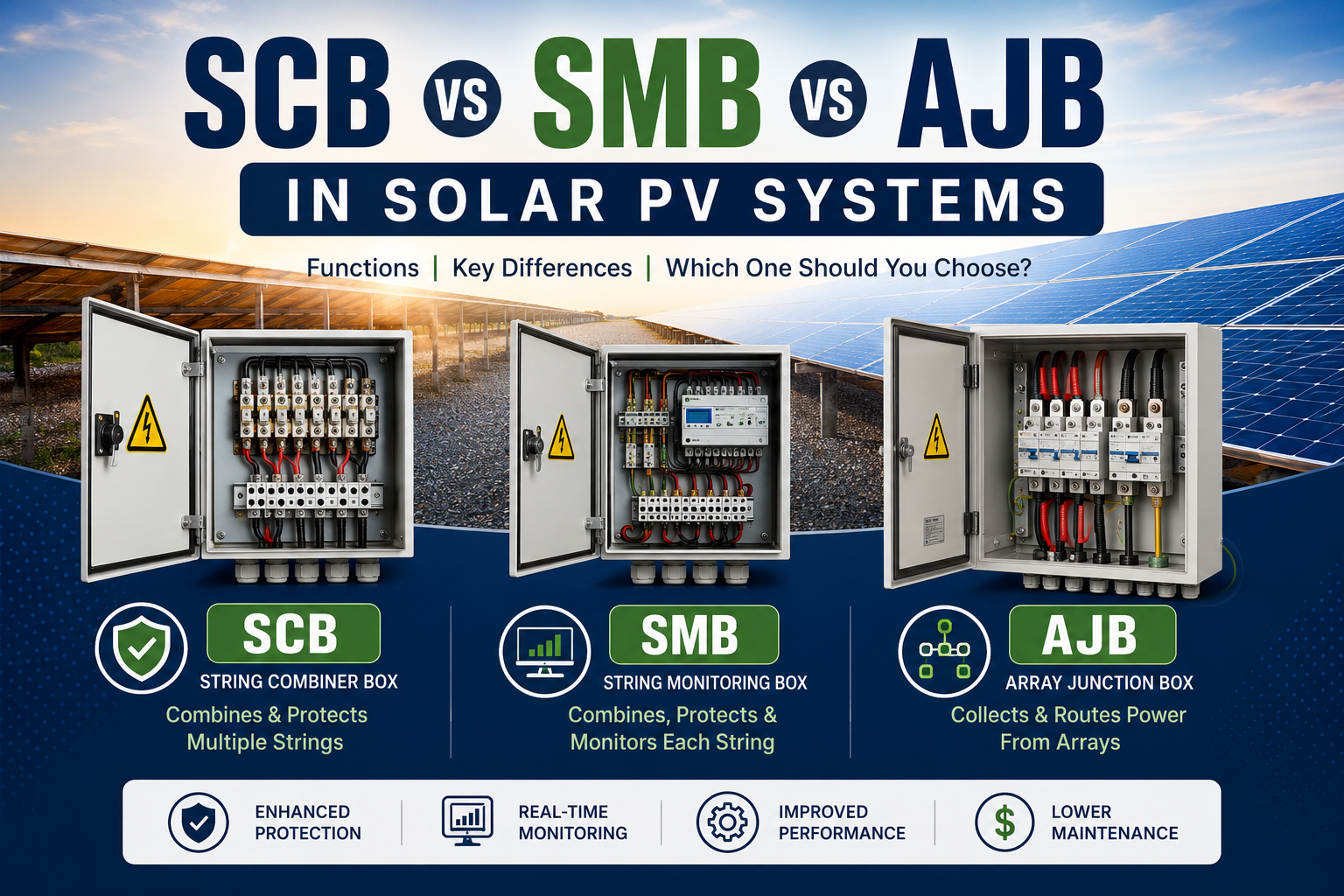
As solar power plants continue to grow in size and complexity, efficient DC power collection and protection become increasingly important. Components such as the String Combiner Box (SCB), String Monitoring Box (SMB), and Array Junction Box (AJB) play a crucial role in ensuring that energy generated by photovoltaic (PV) modules reaches the inverter safely and efficiently.Although these devices are often confused because of their similar appearance, each serves a unique purpose within the DC collection system.In this article, we'll explore the differences between SCB, SMB, and AJB, their internal components, applications, advantages, and how to choose the right one for your solar project.
Quick Summary
SCB: Combines multiple PV strings and provides DC protection.
SMB: Performs all SCB functions and adds real-time monitoring of every string
.AJB: Collects DC power from multiple arrays before it reaches the inverter.aph here
Understanding the DC Side of a Solar Power PlantPower Flow:
Solar Modules → Strings → SCB / SMB → AJB (if used) → DC Cable → Inverter → Transformer → Grid
This arrangement reduces cable losses, improves safety, simplifies maintenance, and enhances system reliability.
What is a String Combiner Box (SCB)?
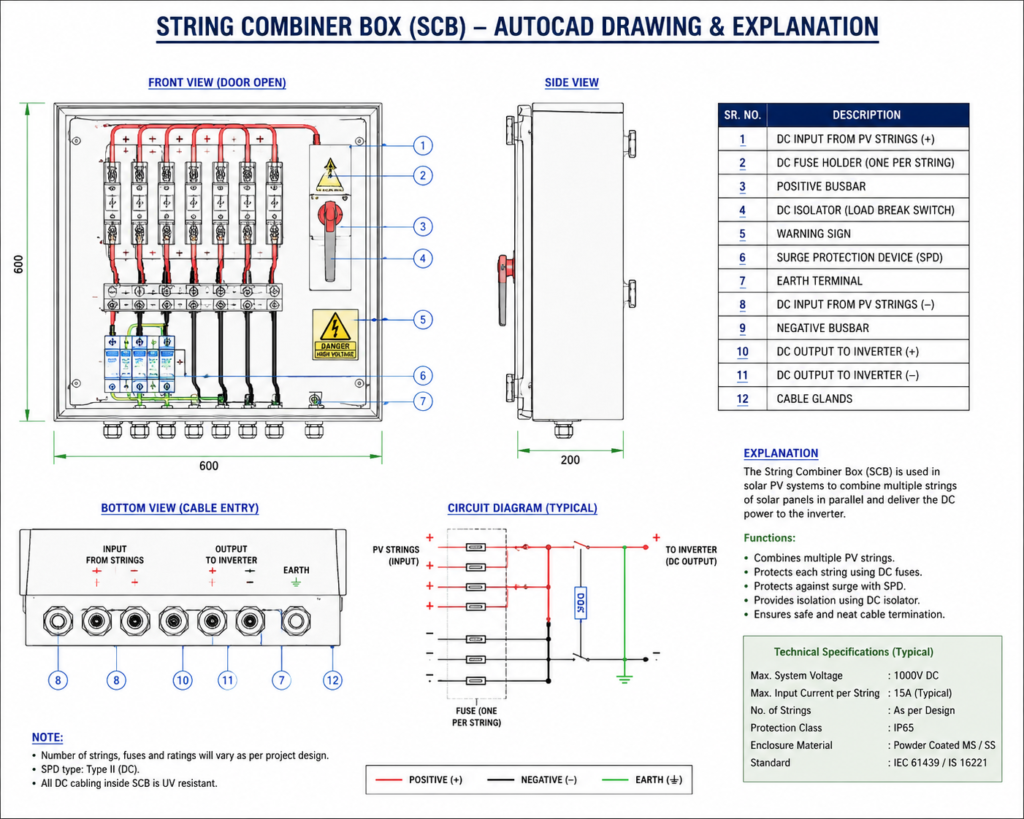
A String Combiner Box (SCB) is one of the most critical components on the DC side of a solar photovoltaic (PV) system. It is an electrical enclosure designed to combine the output of multiple PV strings into a single DC output while providing essential protection and isolation before the power reaches the inverter.In a typical commercial or utility-scale solar power plant, hundreds or even thousands of PV modules are connected in series to form strings. These strings generate DC power independently. Instead of running individual DC cables from every string directly to the inverter, the strings are first terminated inside the SCB, where they are electrically combined.This approach significantly reduces cable quantity, minimizes voltage drop, lowers installation costs, and simplifies future maintenance.
Why is an SCB Required?
Imagine a solar plant with 24 PV strings connected to one inverter.
Without an SCB:
24 positive cables
24 negative cables must run individually to the inverter.
With an SCB:
24 strings enter the SCB.
The outputs are combined into one positive and one negative feeder.
Only two DC output cables are routed to the inverter.
This reduces cable management complexity while improving system safety and reliability.
WHAT IS A STRING MONITORING BOX ?
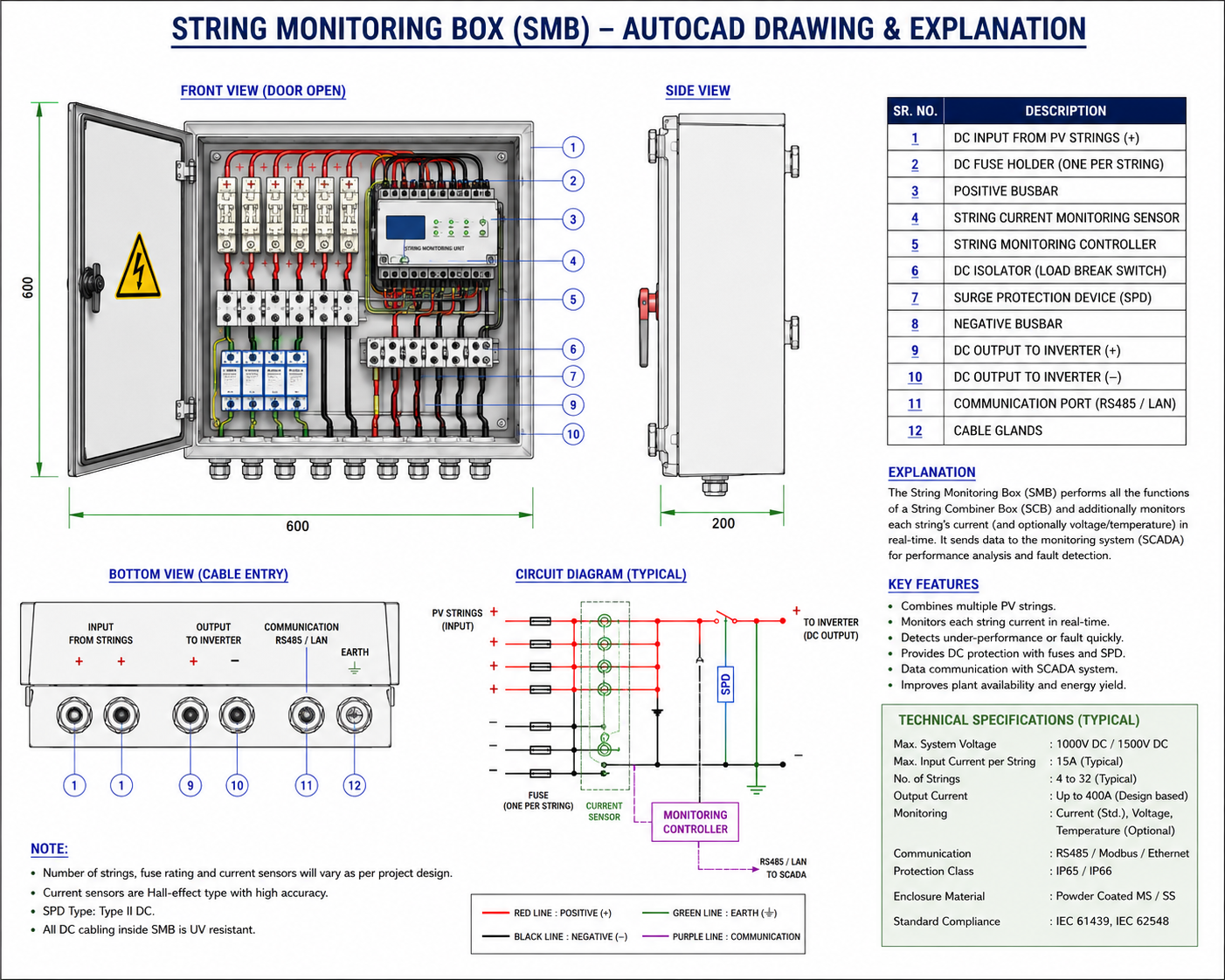
A String Monitoring Box (SMB) is an advanced version of an SCB that not only combines strings but also monitors the electrical performance of each string in real time.The monitoring data is transmitted to the SCADA system, allowing operators to detect underperforming strings immediately.
Additional Features:
Individual string current monitoring
Voltage monitoring
Temperature monitoring
Modbus/RS-485 communication
Ethernet connectivity
SCADA integration
Advantages:
Faster fault detection
Reduced maintenance costs
Higher plant availability
Better energy generation
Improved preventive maintenance
What is an Array Junction Box (AJB)?
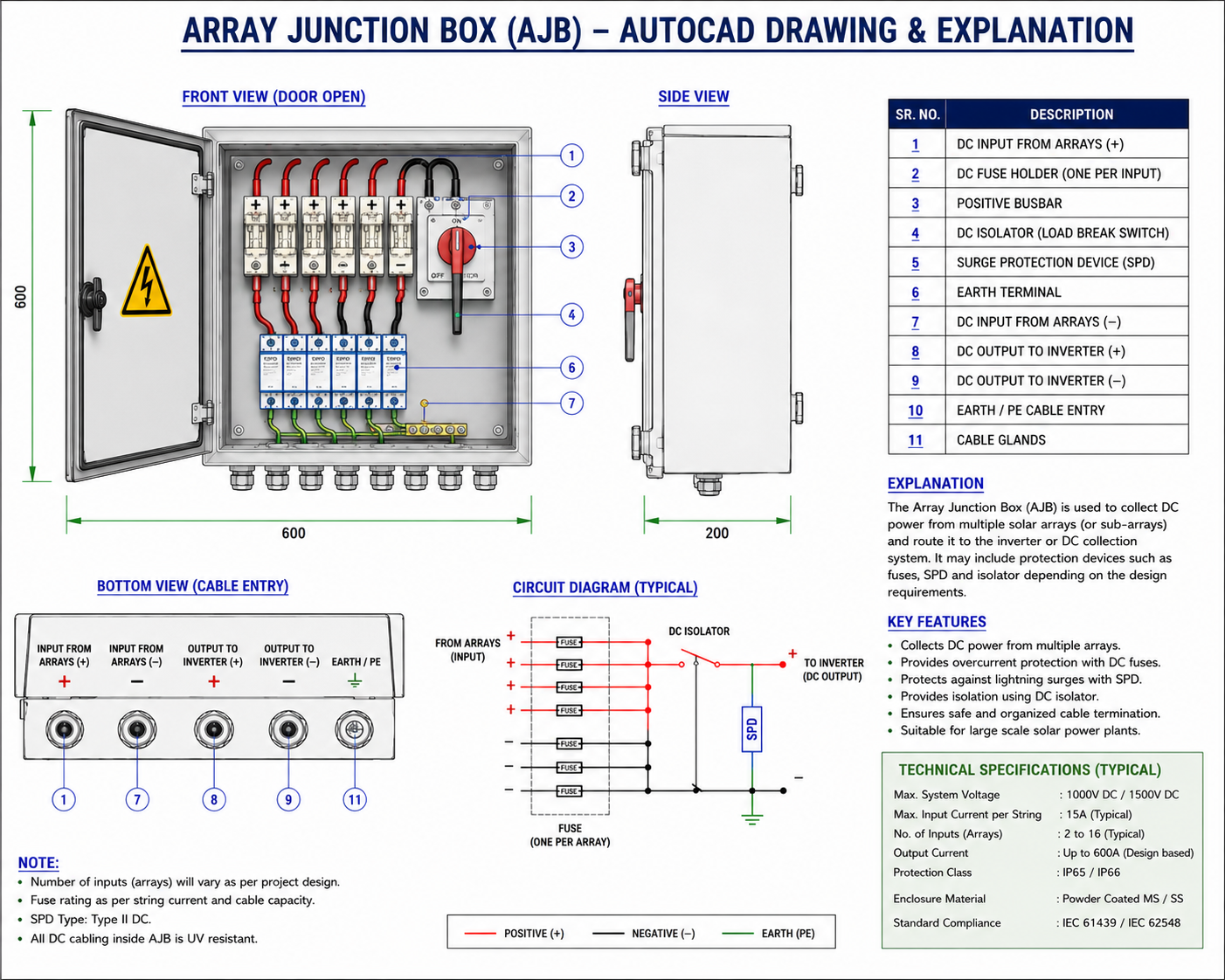
An Array Junction Box (AJB) is a DC collection and protection enclosure used in commercial and utility-scale solar photovoltaic (PV) plants. It collects DC power from multiple solar arrays or sub-arrays and routes the combined output to the inverter or the next level of the DC collection network. Depending on the plant architecture, an AJB may also include DC fuses, surge protection devices (SPDs), DC isolators, busbars, and earthing terminals.
Why is an AJB Required?
Large solar power plants often have several array blocks located far from the inverter. Instead of routing individual cables over long distances, an AJB collects power from multiple arrays, reducing cable quantity, simplifying routing, improving maintenance, and enhancing overall system reliability.
Advantages·
Reduces cable quantity and cost·
Improves safety·
Simplifies maintenance·
Supports large utility-scale plants·
Provides organized DC power collectionImproves plant reliability
Conclusion:
Understanding the differences between the String Combiner Box (SCB), String Monitoring Box (SMB), and Array Junction Box (AJB) is essential for designing safe, reliable, and efficient solar PV systems. Although these components all operate on the DC side of a solar power plant, each serves a distinct purpose.
SCB is primarily responsible for combining multiple PV strings and providing electrical protection through DC fuses, surge protection devices (SPDs), and DC isolators. It is commonly used in residential, commercial, and utility-scale projects to reduce cable quantity and simplify installation.
SMB builds upon the functionality of an SCB by adding real-time monitoring of individual PV strings. It enables continuous measurement of string current, voltage, and, in some designs, temperature. With communication interfaces such as RS-485 or Ethernet, SMBs integrate with SCADA systems, allowing faster fault detection, predictive maintenance, and improved energy yield.
AJB serves as a DC collection and routing point, gathering power from multiple arrays or sub-arrays before transmitting it to the inverter or the next level of the DC collection network. It plays a crucial role in organizing long-distance DC cable routing and improving the reliability of large utility-scale solar plants.
Selecting the appropriate junction box depends on the project's capacity, monitoring requirements, system architecture, and operational goals. While an SCB is suitable for projects requiring basic protection and string combining, an SMB is the preferred choice for plants where performance monitoring and remote diagnostics are essential. An AJB is indispensable in large-scale installations where multiple arrays must be efficiently collected and routed.