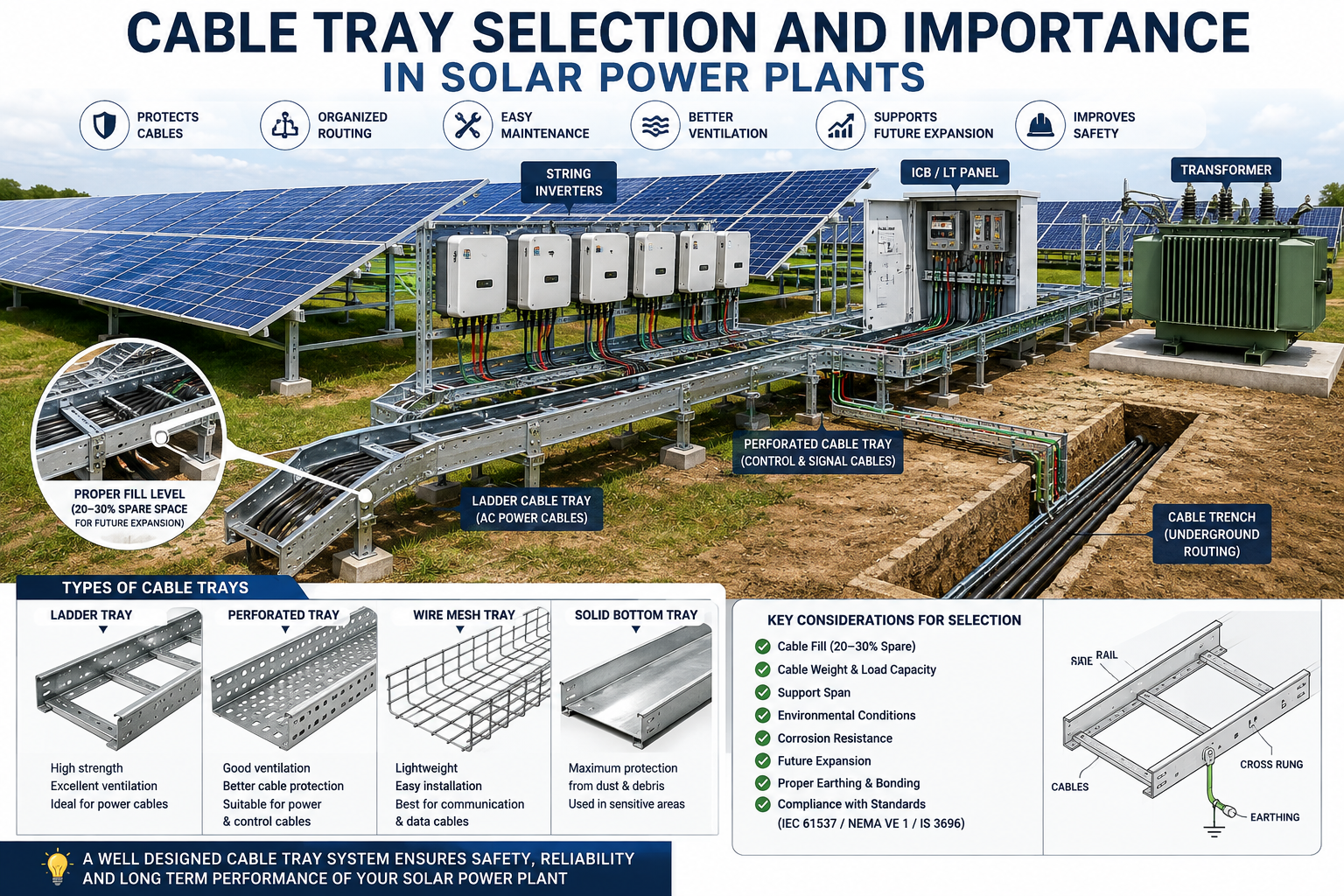
A cable tray is one of the most important components of a solar power plant's electrical infrastructure. Although it does not generate electricity, it plays a critical role in safely supporting, organizing, and protecting the cables that connect solar modules, string inverters, LT panels, transformers, SCADA systems, and auxiliary equipment.
Improper cable tray selection can lead to cable damage, overheating, difficult maintenance, increased installation costs, and reduced system reliability. On the other hand, a properly designed cable tray system simplifies cable routing, improves ventilation, enhances safety, and supports future plant expansion.
In this guide, we explain how to select the correct cable tray for rooftop, ground-mounted, and utility-scale solar power plants.
What Is a Cable Tray?
A cable tray is a structural support system used to carry electrical and communication cables throughout a solar plant.
Instead of running cables directly on the ground or through individual conduits, cable trays provide an organized pathway that keeps cables protected and accessible for inspection and maintenance
Cable trays are commonly installed:Between PV tables and string inverters (where applicable)
Along inverter platforms
Near LT panels and ICBs
Around transformers
Inside inverter or control roomsAlong SCADA and communication routes
Why Are Cable Trays Important?
A properly designed cable tray system provides several benefits:
Supports the weight of electrical cables
Protects cables from mechanical damage
Improves cable organization
Simplifies maintenance and trouble
shootingEnhances ventilation, helping to dissipate heat
Reduces installation time
Allows future cable additions without major rework
Improves the overall appearance of the installation
Without cable trays, cables are more likely to become tangled, damaged, or difficult to identify during maintenance.
Types of Cable Trays Used in Solar Power Plants
1. Ladder Cable Tray
The ladder cable tray consists of two side rails connected by transverse rungs.
Advantages
Excellent ventilation
Suitable for large power cables
High load-carrying capacity
Easy heat dissipation
Ideal for outdoor installations
Typical Applications
AC power cablesDC trunk cablesHT cable routingUtility-scale ground-mounted solar plants
2. Perforated Cable Tray
Perforated trays have a solid base with regularly spaced holes.
Advantages
Good cable support
Better protection than ladder trays
Suitable for medium cable loads
Improved airflow through perforations
Typical Applications
Instrumentation cablesControl cablesSCADA communication cablesSmall power cable installations
3. Wire Mesh Cable Tray
Wire mesh trays are lightweight and easy to modify on site.
Advantages
Easy installation
Good ventilation
Flexible routing
Ideal for communication systems
Typical Applications
Data cables
Fiber optic cables
Ethernet networks
SCADA systems
4. Solid Bottom Cable Tray
These trays provide maximum protection from dust and debris.
Typical Applications
Sensitive instrumentation
Indoor control rooms
Clean environments
Because ventilation is limited, they are generally not preferred for heavily loaded outdoor power cables.
Cable Tray Materials
Selecting the correct material is just as important as selecting the tray type.
Hot-Dip Galvanized Steel (HDG)
Most commonly used in utility-scale solar plants because it offers:
Excellent corrosion resistanceHigh mechanical strengthLong service lifeCost-effective performanceSuitable for most outdoor installations.
Pre-Galvanized Steel
Typically used indoors or in low-corrosion environments.
Lower cost but less corrosion resistance than hot-dip galvanized trays.
Aluminium
Advantages include:
Lightweight
Naturally corrosion resistant
Easy installation
Good appearance
Commonly used where weight reduction is important.
Stainless Steel
Recommended for:
Coastal projects
Chemical plants
Highly corrosive environments
Provides excellent durability but at a higher cost.
How to Select the Correct Cable Tray
Proper cable tray selection depends on several engineering factors.
1. Number of Cables
Determine:
Total number of cables
Cable diameters
Cable categories (DC, AC, communication)
Avoid overcrowding.
Reserve additional space for future expansion.
2. Cable Weight
The tray must safely support the combined weight of all installed cables.
Also consider:Wind loadingMaintenance loadsSafety factors
3. Cable Fill
A cable tray should never be completely filled.
Maintaining spare capacity:
Improves cooling
Simplifies cable installation
Allows future additions
Many projects reserve approximately 20–30% spare space, though the exact requirement should follow the applicable standards and project specifications.
4. Span Between
SupportsLonger support spacing increases tray deflection.
Support spacing should follow:
Manufacturer recommendationsTray load ratingsSite conditionsProper support spacing prevents sagging and maintains structural integrity.
Conclusion
Cable trays are an essential part of every solar power plant, providing safe and organized support for electrical and communication cables. Selecting the correct tray type, material, size, and support arrangement improves cable protection, reduces maintenance effort, enhances system reliability, and allows for future expansion.
By considering cable loading, environmental conditions, support spacing, ventilation, and segregation requirements during the design stage, engineers can develop cable management systems that meet both operational and safety objectives. A well-designed cable tray system is a long-term investment in the performance and maintainability of any rooftop, ground-mounted, or utility-scale solar project.