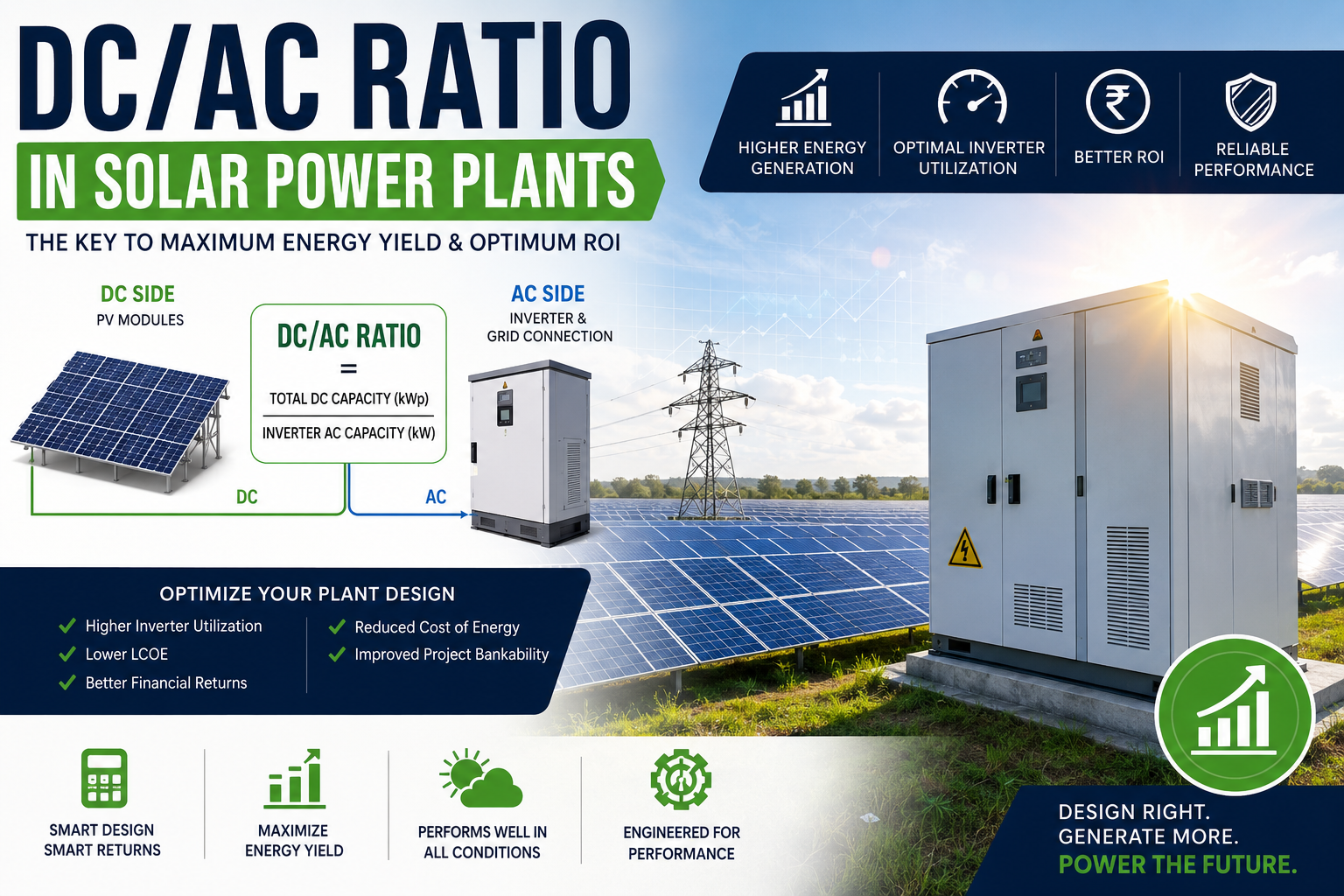
In every solar photovoltaic (PV) project, one of the most critical design decisions is selecting the appropriate DC/AC Ratio, also known as the Inverter Loading Ratio (ILR). This ratio determines the relationship between the installed DC capacity of photovoltaic modules and the AC output capacity of the inverter. Although it appears to be a simple numerical value, it significantly influences the overall energy production, inverter utilization, project economics, system reliability, and long-term return on investment.
Modern solar power plants rarely use a DC/AC ratio of exactly 1.0. Instead, most commercial and utility-scale installations intentionally oversize the DC array. This design approach allows the inverter to operate closer to its rated capacity for longer durations, maximizing annual energy generation despite unavoidable module losses caused by temperature, dust accumulation, aging, and seasonal irradiance variations.
Selecting the wrong DC/AC ratio can lead to substantial financial losses. An undersized DC array results in underutilized inverter capacity, while excessive oversizing causes inverter clipping, where available solar power cannot be converted into usable AC energy. Therefore, finding the optimal balance is one of the most important responsibilities of a solar design engineer.
This guide provides a comprehensive understanding of the DC/AC ratio, including engineering principles, mathematical calculations, practical examples, PVSyst simulation insights, economic considerations, and industry best practices. Whether you are designing a residential rooftop system or a multi-megawatt utility-scale solar plant, mastering this concept is essential for delivering technically sound and economically optimized projects.
What is DC/AC Ratio?
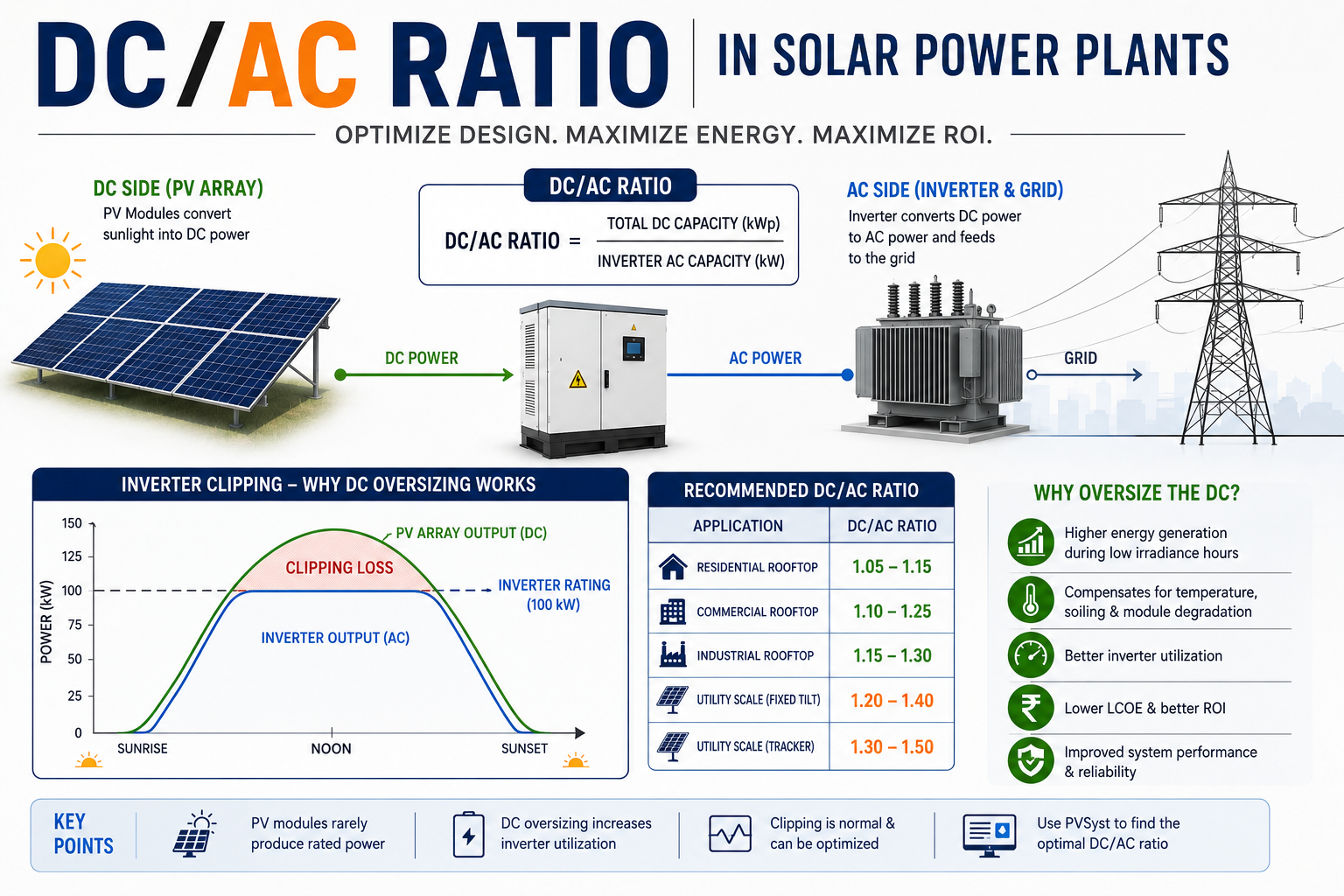
The DC/AC Ratio is defined as the ratio of the total installed DC capacity of the solar PV modules to the rated AC output capacity of the inverter.It is one of the primary parameters used during solar system design and directly affects system performance.
Example 1Suppose a solar plant consists of: PV Modules = 6,600 kWp
Inverter Capacity = 5,000 kW
Then,
DC/AC Ratio=6600/5000
=1.32
Therefore,DC/AC Ratio = 1.32This means the installed solar array is 32% larger than the inverter's AC rating.
Why is DC/AC Ratio So Important?
The DC/AC ratio influences nearly every aspect of a solar project's technical and financial performance.
A properly selected ratio ensures that the inverter operates efficiently across varying irradiance conditions while maximizing annual energy production.
The key impacts include:
Annual Energy Yield Inverter Utilization
Capacity Utilization Factor (CUF)
Plant Performance Ratio (PR)
Return on Investment (ROI)
Levelized Cost of Energy (LCOE)
Project Payback Period
Grid Export Performance
Equipment Sizing
System Reliability
Even a small change in the DC/AC ratio can result in significant differences in annual energy generation and project profitability.
The Concept of DC Oversizing
Since PV modules seldom reach their STC rating, engineers intentionally install more DC capacity than the inverter's AC rating. This practice is known as DC oversizing.
The primary objectives of DC oversizing are: Increase inverter utilization. Improve energy generation during mornings and evenings. Compensate for temperature and seasonal losses. Offset long-term module degradation. Reduce the cost per unit of electricity generated.A properly oversized DC array allows the inverter to operate near its maximum output for a longer portion of the day, increasing annual energy production without significantly increasing inverter costs.
Understanding Inverter Utilization
Consider a 100 kW inverter.If only 80 kW of PV modules are installed, the inverter can never reach its full capacity, leaving part of its capability unused even under ideal conditions.
If 130 kW of PV modules are installed, the inverter will operate at full power more frequently. However, during periods when the DC array can produce more than 100 kW, the inverter will limit its output to 100 kW. This phenomenon is known as inverter clipping, which will be discussed in detail in the next part.
The objective is to select a DC/AC ratio that maximizes annual energy yield while minimizing clipping losses
Inverter Clipping Explained
Once the DC/AC ratio exceeds 1.0, the solar PV array has the potential to produce more power than the inverter is capable of converting into AC electricity during periods of high irradiance. When this occurs, the inverter limits its output to its rated AC capacity, and any additional DC power generated by the PV modules is not converted into usable AC energy. This phenomenon is known as Inverter Clipping.
Inverter clipping is not a system fault. It is an intentional design strategy adopted by solar engineers worldwide to improve annual energy generation and reduce project costs. While clipping results in some energy loss during peak sunshine hours, the additional energy harvested during mornings, evenings, cloudy conditions, and winter months generally outweighs these losses, leading to a higher annual energy yield.
For example, consider a solar power plant equipped with a 100 kW inverter and a 130 kWp PV array, giving a DC/AC ratio of 1.30. During early morning, the array may produce only 20–40 kW, allowing the inverter to convert all available power. Around solar noon, the array may briefly generate 118–125 kW due to favorable irradiance and temperature conditions. Since the inverter is rated at only 100 kW AC, it limits its output to 100 kW, and the remaining 18–25 kW is clipped.
For example, consider a solar power plant equipped with a 100 kW inverter and a 130 kWp PV array, giving a DC/AC ratio of 1.30. During early morning, the array may produce only 20–40 kW, allowing the inverter to convert all available power. Around solar noon, the array may briefly generate 118–125 kW due to favorable irradiance and temperature conditions. Since the inverter is rated at only 100 kW AC, it limits its output to 100 kW, and the remaining 18–25 kW is clipped.
Although this appears to be an energy loss, the oversized DC array enables the inverter to operate at or near full capacity for a much longer duration throughout the day. Consequently, the total annual energy production increases, which is the primary objective of DC oversizing.
Why Engineers Intentionally Allow Clipping
Many beginners assume that clipping should always be avoided. In reality, designing a system with zero clipping would require installing a much larger inverter, significantly increasing capital costs while providing only marginal gains in annual energy production.
Instead, engineers optimize the balance between inverter cost and energy yield. By allowing a controlled amount of clipping—typically resulting in annual clipping losses of 0.5% to 3%—the project can achieve a lower Levelized Cost of Energy (LCOE) and a better Return on Investment (ROI).
How to Select the Optimum DC/AC Ratio
Selecting the correct DC/AC ratio is one of the most important engineering decisions during the design of a solar power plant. While there is no universal value suitable for every project, experienced design engineers determine the optimum ratio by evaluating technical performance, climatic conditions, financial viability, and grid regulations. The objective is not simply to maximize the DC capacity or minimize inverter clipping, but to achieve the lowest Levelized Cost of Energy (LCOE) and the highest Return on Investment (ROI) over the plant's operational life.
An ideal DC/AC ratio should ensure that the inverter operates efficiently throughout the year while maintaining clipping losses within an economically acceptable range. This balance varies depending on project type, geographical location, module technology, inverter specifications, and grid export limitations.
How PVSyst Determines the Optimum DC/AC Ratio
PVSyst is one of the most widely used simulation tools for solar PV system design. It evaluates the effect of different DC/AC ratios by simulating hourly weather data, irradiance, module temperature, system losses, and inverter behavior.
During simulation, PVSyst calculates:
PV Array Output
Inverter Efficiency
Inverter Clipping Losses
Thermal Losses
Module Mismatch Losses
DC Cable Losses
AC Cable Losses
Energy Injected into the Grid
By comparing annual energy production and clipping losses across multiple DC/AC ratios, engineers can identify the configuration that offers the highest financial return.
Financial Impact of DC Oversizing
Oversizing the DC array generally provides a better return than installing a larger inverter because:
PV module prices have decreased significantly in recent years.
Inverter costs remain relatively higher per unit of additional AC capacity.
A larger DC array increases energy production during low-irradiance periods.
Higher annual generation reduces the Levelized Cost of Energy (LCOE).
However, excessive oversizing can reduce the economic benefit if clipping losses become too high. Therefore, the final ratio should always be validated using a simulation tool such as PVSyst.