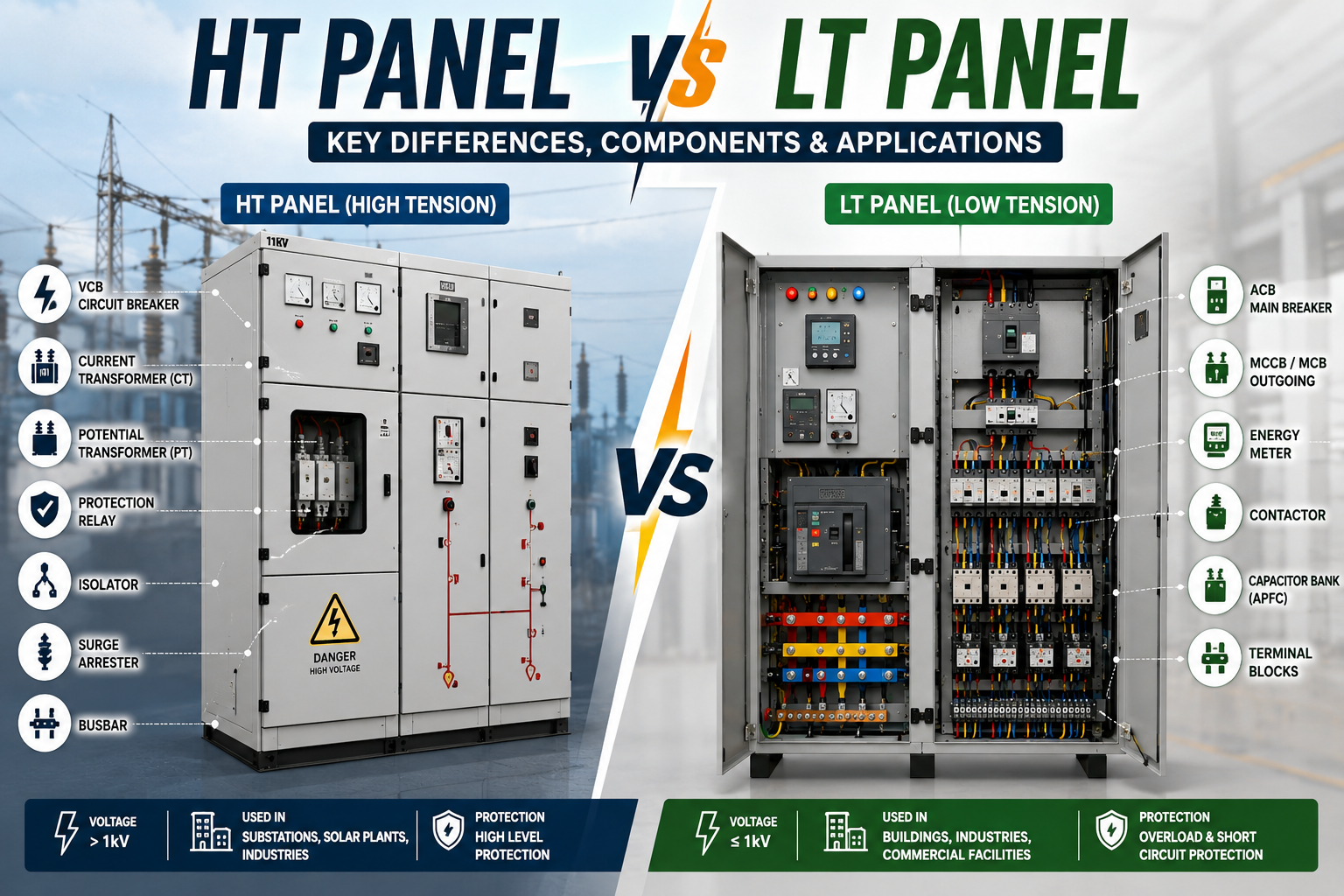
HT Panel vs LT Panel
HT Panel vs LT Panel – Short DefinitionHT Panel (High Tension Panel):
An HT panel is used for medium/high-voltage electrical power distribution and protection, typically on the incoming/outgoing side of transformers and grid connections. It commonly includes VCB, CT, PT, protection relays, and isolators.LT Panel (Low Tension Panel):
An LT panel is used for low-voltage power distribution and control after the transformer. It commonly includes ACB/MCCB, MCB, contactors, meters, and protection devices.
What is an HT Panel?
In every electrical power distribution system, electricity passes through different voltage levels before reaching consumers. Two of the most important electrical distribution panels are the HT (High Tension) Panel and LT (Low Tension) Panel.Whether it is a solar power plant, industrial facility, commercial building, or utility substation, HT and LT panels play a crucial role in controlling, protecting, and distributing electrical power safely.This article explains HT and LT panels in detail, their components, working principles, applications, and differences.
An HT (High Tension) Panel is an electrical switchgear panel designed to control, protect, and distribute electrical power operating at voltages above 1 kV AC.In India, HT panels are commonly available for: 3.3 kV 6.6 kV 11 kV 22 kV 33 kVThese panels receive power from the utility or substation and feed transformers or large industrial loads.
In power distribution systems, an HT panel plays a crucial role in managing high-voltage electricity. The HT panel full form stands for High Tension panel, which means it is designed to handle voltages above 11kV, commonly used in industrial and commercial power systems. These panels control, distribute, and regulate electrical power efficiently, ensuring stability and protection across large-scale operations.
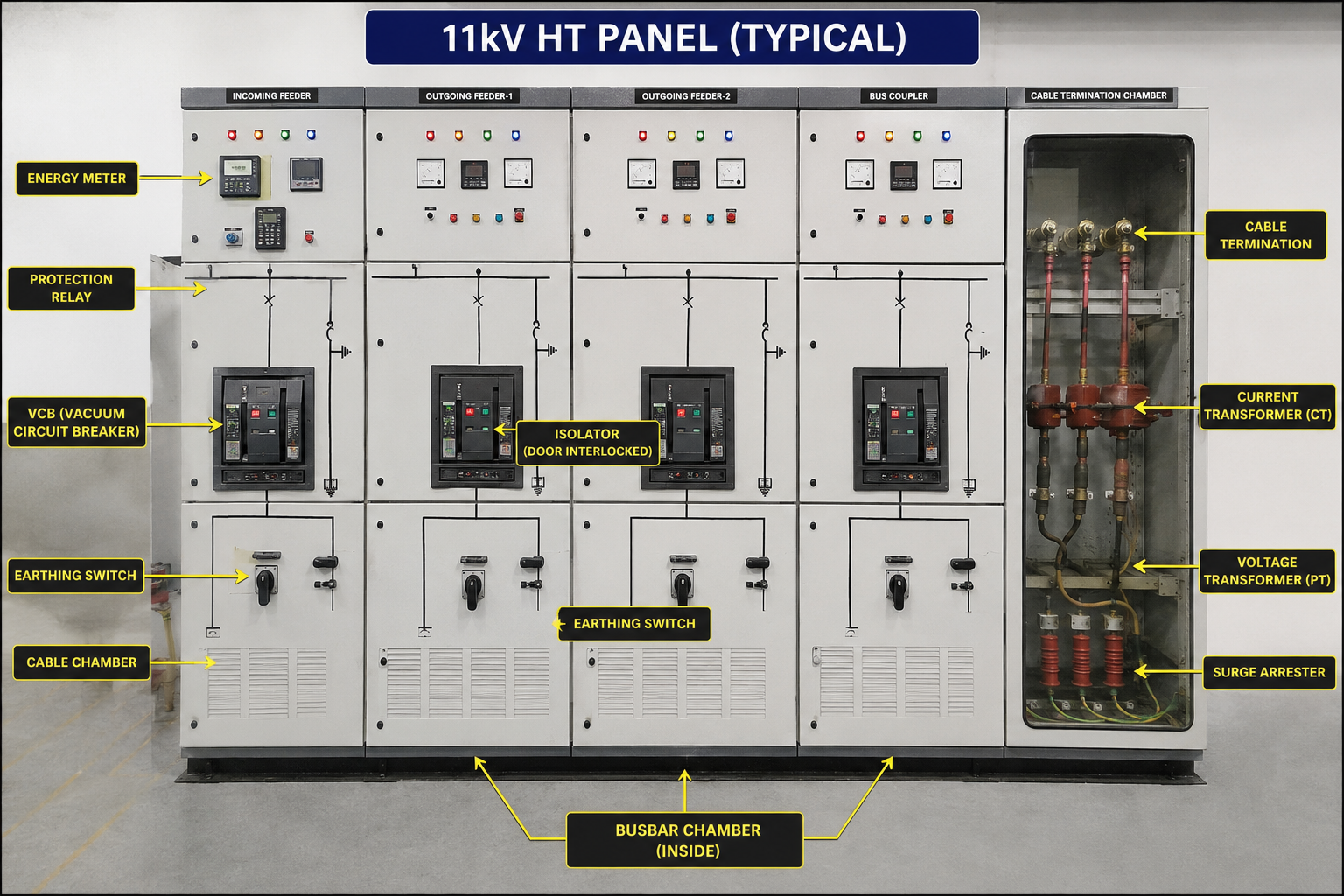
Main Components of an HT Panel1.
1.Vacuum Circuit Breaker (VCB)-The VCB interrupts current during abnormal conditions using vacuum as the arc extinguishing medium.
Functions:
Short circuit protection
Overload protection
Fault isolation
2. Current Transformer (CT)
Measures current and supplies scaled current to:
Protection relays Energy meters
SCADA systems
3. Potential Transformer (PT)
Reduces high voltage to a measurable level for:
Voltage monitoring Metering Protection relays
4. Protection RelaysModern
HT panels use numerical relays that provide:
Overcurrent protection
Earth fault protection
Differential protection
Under/Over voltage protection
Frequency protection
5. Busbar
Heavy-duty copper or aluminum conductors that distribute power between incoming and outgoing feeders.
6. Isolator
Provides visible isolation for maintenance.
It should only be operated when no load current is flowing
7. Lightning Arrestor
Protects HT equipment against lightning surges and switching surges.
8. Metering Section
Includes: Energy Meter Ammeter Voltmeter Multifunction Meter Power Factor Meter
How Does an HT Panel Work?
The HT panel receives high-voltage power from the utility or substation. The incoming VCB controls and protects the feeder. CTs and PTs continuously measure current and voltage and send signals to protection relays. If a fault such as an overload, short circuit, or earth fault occurs, the relay commands the VCB to trip, isolating the faulted section and protecting equipment. Under normal operation, the panel distributes power to transformers or other HT loads.
What is an LT Panel?
In power distribution systems, an LT panel is responsible for managing low-voltage electricity in industrial, commercial, and residential setups. The LT panel full form stands for Low Tension panel, which means it is designed to handle voltages below 1,000V. These panels ensure safe and efficient distribution of electricity to various electrical loads while offering protection against overloads and short circuits.
An LT (Low Tension) Panel is an electrical distribution panel used for voltages up to 1,000 V AC. It receives power from the secondary side of a transformer and distributes it safely to various electrical loads.Common LT voltage levels include:
230 V (Single Phase)
415 V (Three Phase)
690 V (Industrial)
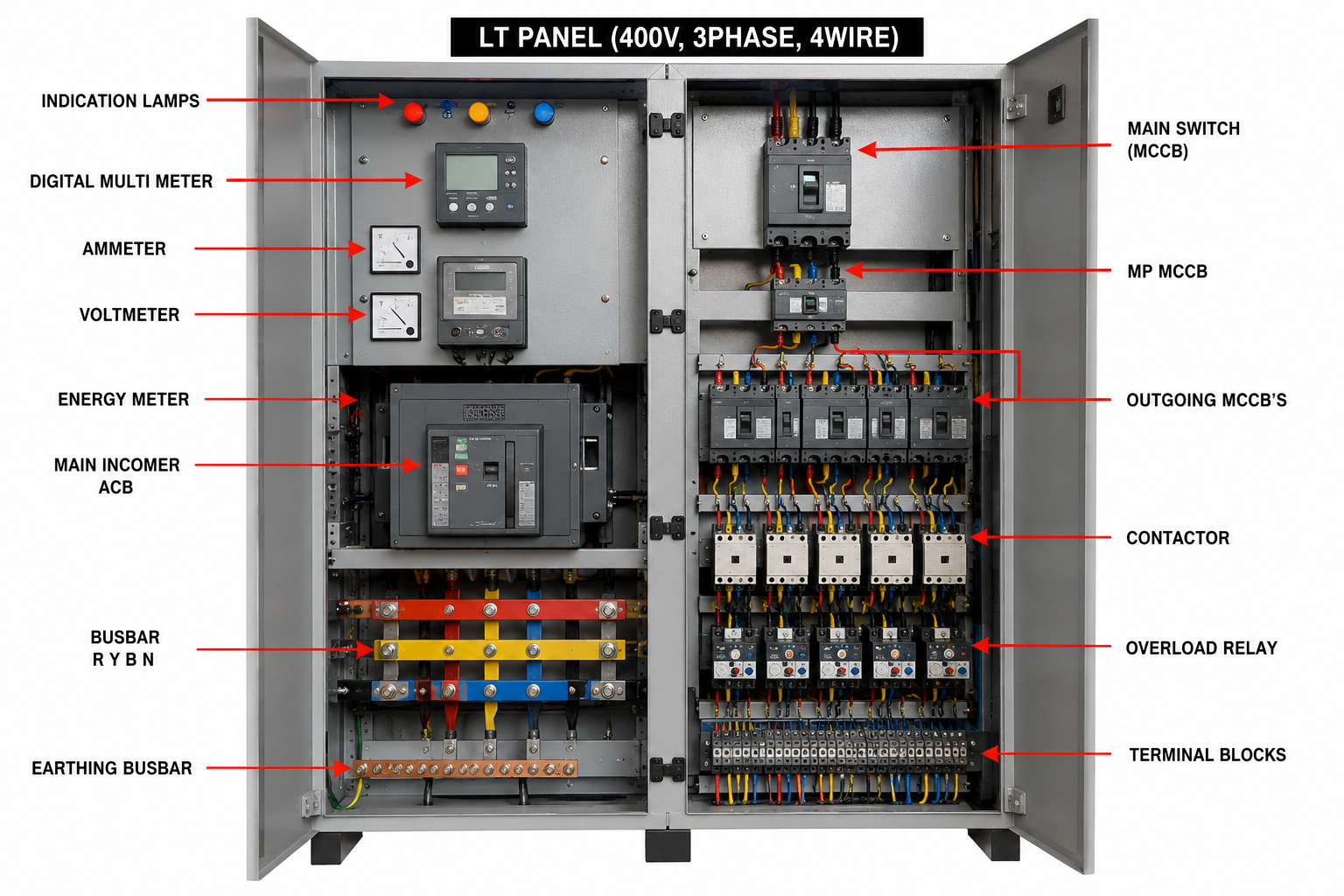
Main Components of an LT Panel1.
1.Air Circuit Breaker (ACB)
Used as the main incoming breaker.
Typical ratings: 630 A 800 A 1250 A 1600 A 2500 A 3200 A 4000 A
2. Molded Case Circuit Breaker (MCCB)
Used for outgoing feeders.Provides: Overload Protection Short Circuit Protection
3. Miniature Circuit Breaker (MCB)
Protects lighting and small power circuits.
4. Busbars
Copper or aluminum busbars distribute electrical power throughout the panel.
5. Energy Meter
Measures electrical energy consumption.
6. Multifunction Meter
Displays:
Voltage
Current
Frequency Power
Factor Active
Power Reactive Power
7. Contactors
Used for automatic switching of motors and other electrical loads.
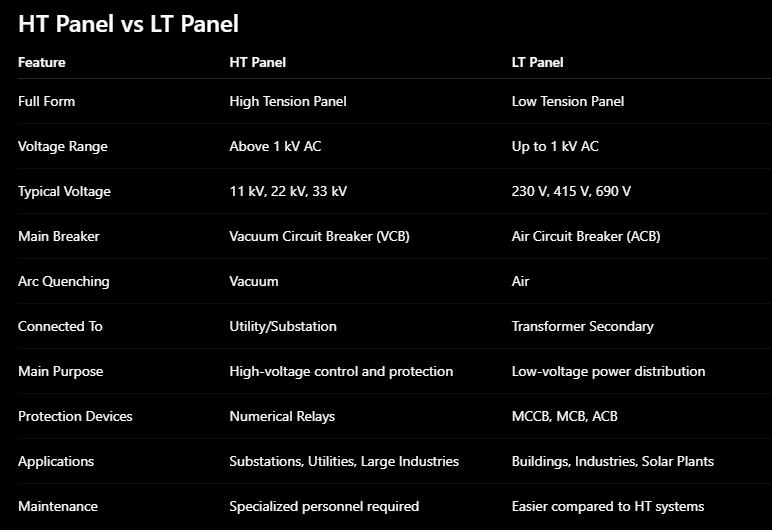
Conclusion
HT and LT panels are essential components of every electrical power distribution system. HT panels manage and protect high-voltage networks before power reaches transformers, while LT panels distribute low-voltage power safely to end-use equipment. Understanding their construction, operation, and differences is fundamental for electrical and solar engineers involved in the design, operation, and maintenance of power systems.