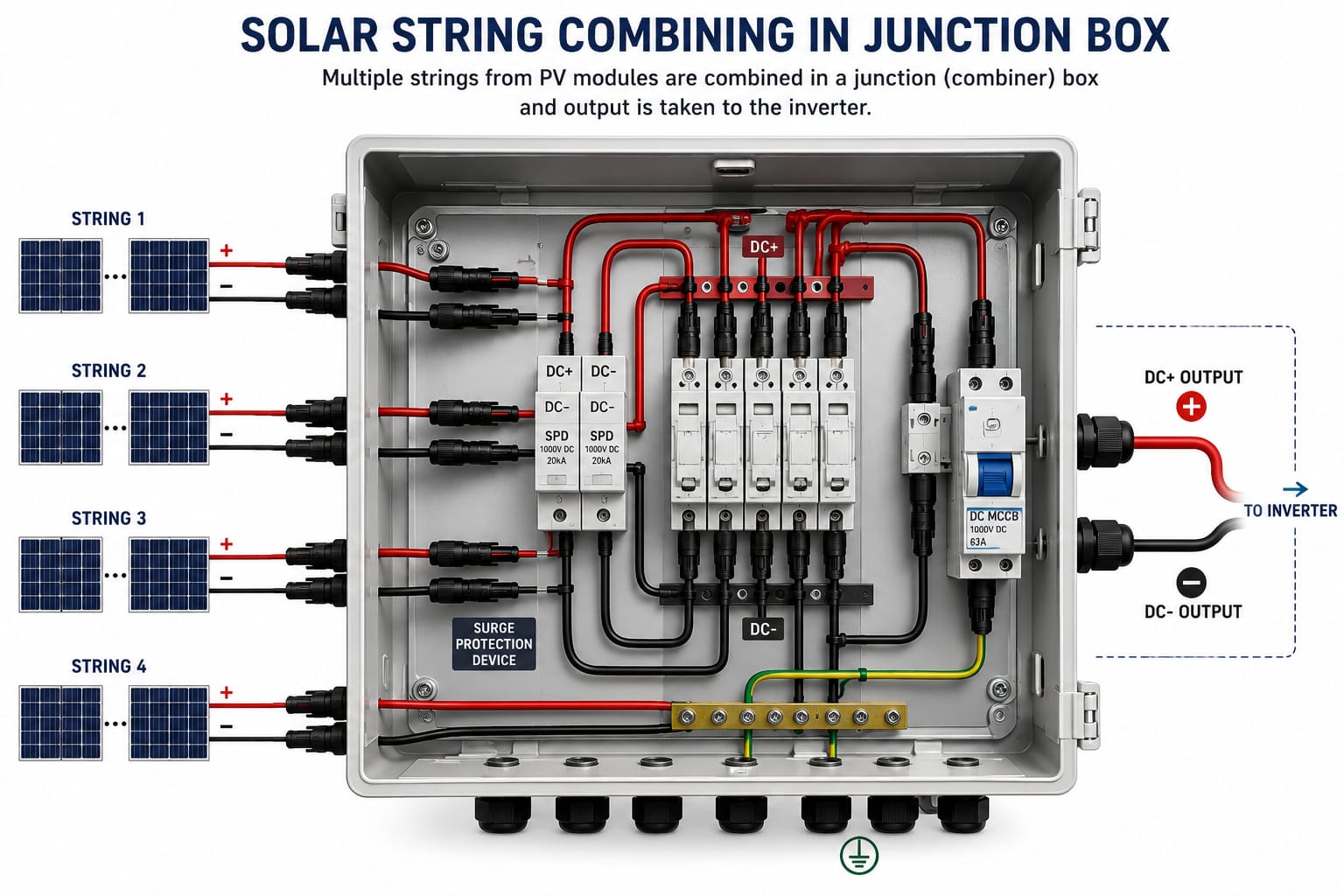
Introduction
Junction boxes play a vital role in ensuring the safe and reliable operation of solar photovoltaic (PV) systems. They provide secure electrical connections, protect circuits from environmental conditions, simplify maintenance, and improve overall system safety.
In utility-scale ground-mounted solar power plants, several types of junction boxes are used, each serving a specific function within the DC or AC electrical network. Selecting the correct junction box requires consideration of electrical ratings, environmental conditions, cable entry arrangements, enclosure protection, and compliance with international standards.
This guide explains how professional engineers select junction boxes for large-scale solar PV projects.
What is a Junction Box?
A junction box is an enclosure that houses electrical connections while protecting them from moisture, dust, mechanical damage, and accidental contact.
Its primary purpose is to provide a safe location for cable terminations, electrical connections, and protective devices.
Types of Junction Boxes Used in Solar PV Systems
1. Module Junction Box
Installed on the back of every solar module.
Functions
- Connects solar cells internally.
- Houses bypass diodes.
- Provides positive and negative output terminals.
- Prevents hotspot formation.
- Protects electrical connections.
2. Array Junction Box (AJB)
Collects several PV strings before they are connected to an inverter or string combiner.
Typical Applications
- Large rooftop systems
- Utility-scale plants
- Floating solar plants
3. String Combiner Box (SCB)
Combines multiple strings into a single DC output while providing protection and monitoring.
Typical Components
- DC Fuse
- DC SPD
- DC Isolator
- String Monitoring
- Busbar
4. AC Junction Box
Used on the AC side of the inverter.
Functions
- Combines AC circuits.
- Houses protection devices.
- Provides safe cable terminations.
- Simplifies maintenance.
5. Field Junction Box
Used for communication, instrumentation, SCADA, weather stations, and field devices.
Factors to Consider When Selecting a Junction Box
1. System Voltage
The junction box voltage rating must exceed the maximum DC system voltage.
Typical utility-scale systems use:
- 1000 V DC
- 1500 V DC
Always select a box with a higher voltage rating than the operating voltage.
2. Current Rating
Determine the maximum current passing through the junction box.
Example:
16 strings
String Current = 18 A
Total Current
16 × 18
= 288 A
The selected junction box should safely handle this current with an adequate safety margin.
3. Number of Cable Entries
Cable entries depend on the number of incoming and outgoing cables.
Typical considerations include:
- Number of strings
- Spare entries for future expansion
- Separate entries for communication cables (if required)
- Cable gland sizes
4. Ingress Protection (IP Rating)
Utility-scale solar plants operate in harsh outdoor environments.
Recommended minimum ratings:
- IP65
- IP66
These ratings protect against dust and water ingress.
5. UV Resistance
Outdoor enclosures are exposed to continuous sunlight.
The enclosure material should:
- Resist ultraviolet radiation.
- Maintain mechanical strength over time.
- Avoid discoloration and cracking.
6. Operating Temperature
Typical operating range:
-25°C to +60°C
For hotter climates, ensure the enclosure and internal components are rated for higher temperatures or provide ventilation where appropriate.
7. Enclosure Material
Common options:
Polycarbonate
Advantages:
- Lightweight
- Corrosion-resistant
- UV-resistant
- Electrically insulating
Best suited for standard outdoor installations.
Mild Steel
Advantages:
- High mechanical strength
- Good for industrial environments
Requires corrosion protection.
Stainless Steel
Advantages:
- Excellent corrosion resistance
- Long service life
Commonly used in coastal and chemical environments.
8. Surge Protection
Install suitable DC Surge Protection Devices (SPDs) to protect equipment from lightning-induced surges.
Select SPDs based on:
- System voltage
- Discharge current rating
- Protection level
- Applicable standards
9. Cable Glands
Select cable glands according to:
- Cable outer diameter
- Cable type
- IP rating
- UV resistance
- Material (brass, stainless steel, nylon)
10. Standards Compliance
The junction box should comply with relevant international standards such as:
- IEC 61439 (Low-voltage switchgear assemblies)
- IEC 60529 (Ingress protection)
- IEC 62548 (PV array design)
- IEC 61643 (Surge protection devices)
Typical Junction Box Selection Example
Project
- 10 MW Utility-Scale Solar Plant
System Voltage
- 1500 V DC
Number of Strings
- 24
String Current
- 18 A
Recommended Junction Box Features
- 1500 V DC rated enclosure
- 24 string inputs
- 1 main DC output
- DC fuses for each string
- Type II DC SPD
- Lockable DC isolator
- IP66 enclosure
- UV-resistant polycarbonate or stainless steel body
- MC4-compatible cable entries
- Suitable current rating with engineering margin
Common Mistakes in Junction Box Selection
- Selecting a voltage rating lower than the system voltage.
- Undersizing the current capacity.
- Ignoring future expansion requirements.
- Using low IP-rated enclosures outdoors.
- Choosing non-UV-resistant materials.
- Installing undersized cable glands.
- Omitting surge protection.
- Poor cable management leading to water ingress or overheating.
Best Practices
- Choose a junction box with at least a 20–25% current margin.
- Match the enclosure material to the site environment.
- Use high-quality cable glands and sealing accessories.
- Verify compatibility with the selected inverter and cables.
- Ensure compliance with project specifications and international standards.
- Plan for maintenance by providing adequate internal space and clear labeling.
What is the difference between an AJB
Which IP rating is recommended for outdoor solar junction boxes
Why is
How should
Conclusion
Junction boxes are critical components of a solar PV system, providing safe electrical connections, environmental protection, and integration of protective devices. Proper selection requires careful evaluation of voltage and current ratings, enclosure material, ingress protection, cable management, surge protection, and compliance with applicable standards. By following sound engineering practices, designers can improve system reliability, simplify maintenance, and ensure long-term performance in utility-scale solar installations.