String Calculation in Solar PV Systems: A Complete Beginner-to-Professional Guide
What is String Calculation?
String calculation is the process of determining how many solar modules can be connected in series (called a string) without exceeding the inverter’s voltage and current limits. It is one of the most important steps in designing a safe, efficient, and reliable solar PV system.
A correct string design ensures:
– Maximum energy generation
– Safe inverter operation
– Compliance with electrical standards
– Reduced system losses
– Longer equipment life
—
What is a Solar String?
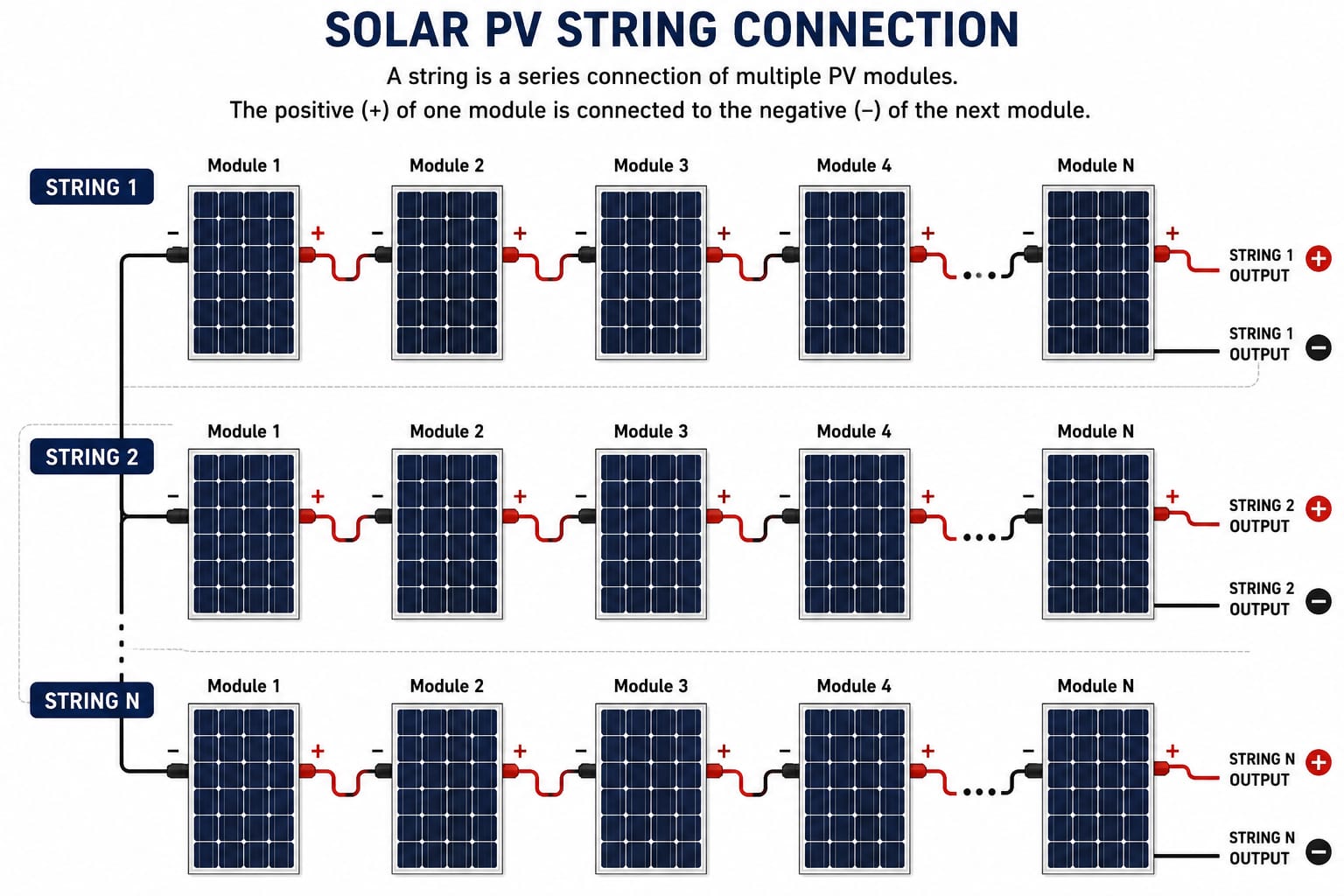
A solar string is a group of photovoltaic (PV) modules connected in series. When modules are connected in series:
– Voltage (V) adds together.
– Current (A) remains the same.
For example:
– Module Voltage (Vmp): 42 V
– Module Current (Imp): 14 A
– Number of Modules: 20
String Voltage = 42 × 20 = 840 V
String Current = 14 A
—
Module Parameters Required
Before performing string calculations, collect the following data from the PV module datasheet:
– Open Circuit Voltage (Voc)
– Maximum Power Voltage (Vmp)
– Short Circuit Current (Isc)
– Maximum Power Current (Imp)
– Temperature Coefficient of Voc (%/°C)
– Maximum System Voltage
—
Inverter Parameters Required
From the inverter datasheet, note:
– Maximum DC Input Voltage
– MPPT Voltage Range
– Start-up Voltage
– Number of MPPTs
– Maximum Input Current per MPPT
– Maximum Short Circuit Current
– Maximum Number of Inputs
—
Step 1: Calculate Maximum Modules per String
The maximum number of modules depends on the inverter’s maximum DC voltage and the corrected module Voc at the lowest expected site temperature.
Formula
Corrected Voc = Voc × [1 + (Temperature Coefficient × (25 − Lowest Site Temperature))]
Maximum Modules per String = Maximum DC Voltage ÷ Corrected Voc
Always round the result down to the nearest whole number.
—
Step 2: Calculate Minimum Modules per String
The minimum number of modules should ensure that the string voltage remains above the inverter’s minimum MPPT voltage during the highest expected site temperature.
Formula
Minimum Modules = Minimum MPPT Voltage ÷ Corrected Vmp at Highest Temperature
Always round the result up to the nearest whole number.
—
Step 3: Verify Current Limits
When multiple strings are connected in parallel:
Total Current = Number of Strings × Module Imp
Ensure this value does not exceed the inverter’s maximum input current.
Similarly,
Total Short Circuit Current = Number of Strings × Module Isc
This should remain below the inverter’s maximum allowable short-circuit current.
—
Example Calculation
PV Module
– Power: 620 W
– Voc: 48.5 V
– Vmp: 41.5 V
– Isc: 15.8 A
– Imp: 14.95 A
– Temperature Coefficient of Voc: -0.28%/°C
Inverter
– Maximum DC Voltage: 1500 V
– MPPT Voltage Range: 860–1300 V
Assume:
– Lowest Site Temperature = -10°C
Corrected Voc:
48.5 × [1 + (0.0028 × 35)]
= 53.25 V
Maximum Modules:
1500 ÷ 53.25 = 28.16
Maximum modules per string = 28 Modules
—
Common Design Mistakes
– Ignoring temperature correction
– Exceeding inverter DC voltage limits
– Using the wrong module datasheet
– Ignoring MPPT voltage range
– Overloading MPPT current
– Not checking local electrical standards
—
Best Practices
– Always use the latest module and inverter datasheets.
– Consider both minimum and maximum site temperatures.
– Keep string lengths consistent within the same MPPT whenever possible.
– Validate the design using professional software such as PVsyst.
– Double-check voltage and current calculations before finalizing the design.
—
Conclusion
String calculation is the foundation of every solar PV design. A well-designed string configuration improves system efficiency, protects the inverter, and ensures long-term reliability. Every solar design engineer should master string calculations before moving to detailed layout and electrical design.
Understanding these principles will help you design safe, optimized, and bankable solar power plants ranging from residential rooftop systems to multi-megawatt utility-scale projects.