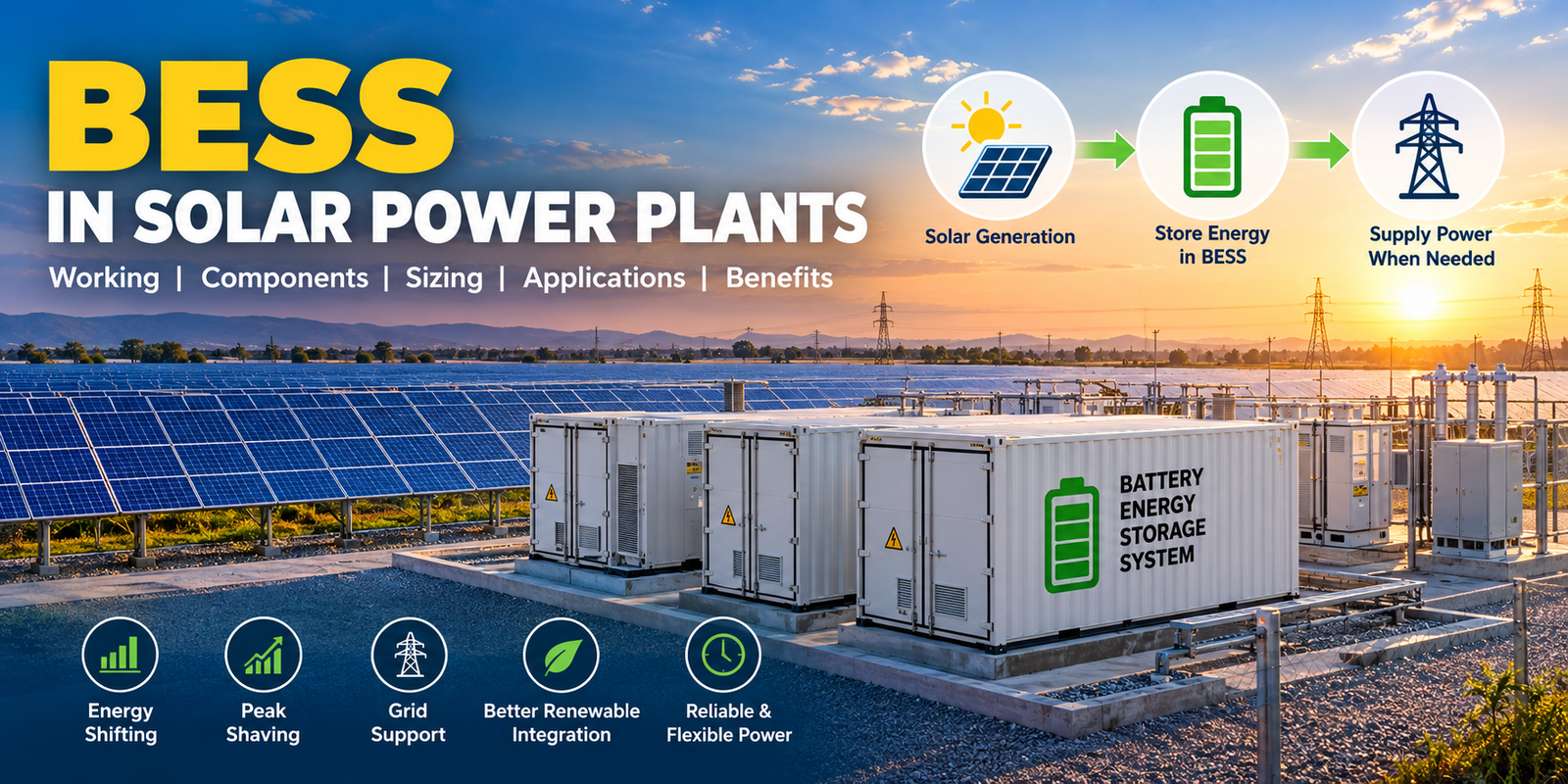
BESS in Solar Power Plants: Complete Guide to Battery Energy Storage Systems
Solar power has become one of the fastest-growing sources of renewable energy. However, solar generation has one major limitation: solar energy is available only when sunlight is available.
Solar generation typically peaks around midday, while electricity demand may remain high during the evening. This mismatch between solar generation and electricity demand creates a strong need for energy storage.
This is where a Battery Energy Storage System (BESS) becomes important.
A BESS can store excess electricity generated by a solar power plant during the day and supply that stored energy when solar generation is low or electricity demand is high.In this article, we will understand
what BESS is, how it works with a solar power plant, major components, BESS sizing, battery capacity calculations, applications, advantages, limitations, and important design considerations.
What is BESS?
BESS stands for Battery Energy Storage System.
It is a system that stores electrical energy in batteries and releases that energy when required.
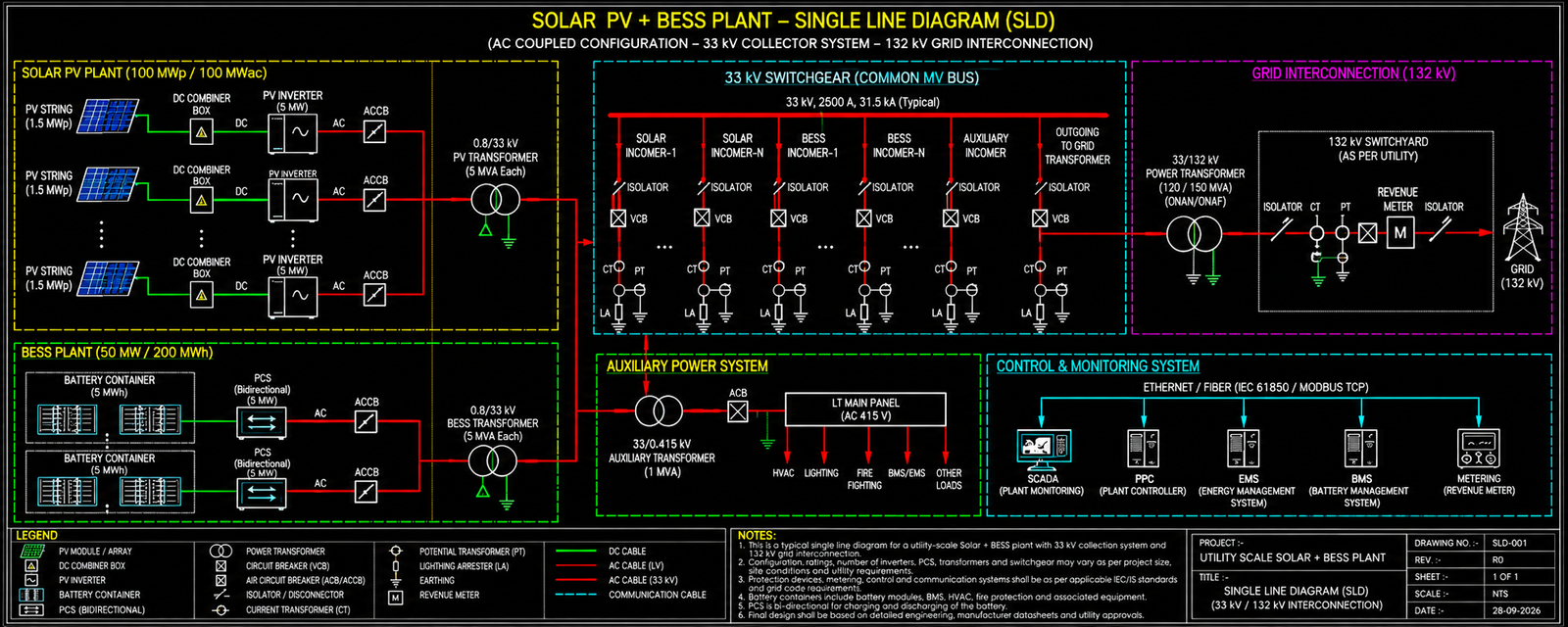
In a solar power plant, BESS can be connected to the DC side or AC side depending on the project architecture.
A typical BESS consists of:
Battery cells
Battery modules
Battery racks
Battery Management System (BMS)
Power Conversion System (PCS)
Energy Management System (EMS)
HVAC system
Fire detection and suppression system
DC protection
AC protection
Transformer
Switchgear
Monitoring and communication systems
The battery stores energy in kWh or MWh, while the PCS is generally rated in kW or MW.
For example:
20 MW / 40 MWh BESS
means the system can theoretically deliver
:20 MW power
for approximately 2 hours
giving a total energy capacity of 40 MWh
Why is BESS Required in Solar Power Plants?
Solar power plants have variable generation.
Time Solar Generation
6 AM Low
9 AM Medium
12 PM High
2 PM High
5 PM Low
7 PM Zero
Electricity demand, however, may increase during the evening.
Without storage, excess solar generation during periods of low demand may need to be curtailed or exported depending on grid conditions and the project's power purchase arrangement.
BESS can help shift energy from one period to another.
Example :
Suppose a solar plant generates:
100 MWh of excess energy during the afternoon.
Instead of immediately exporting all of it, the BESS can store a portion of that energy and discharge it later.
This process is commonly called:
Solar Energy ShiftingSolar generation → Battery charging → Energy storage → Evening discharge
How Does BESS Work With a Solar Power Plant?
A simplified solar + BESS system can be represented as:
SOLAR PV PLANT
▼
DC COLLECTION
▼
INVERTERS
▼
AC COLLECTION
┌──────┴──────┐
│ │
▼ ▼
GRID BESS
▼
PCS
▼
TRANSFORMER
▼
GRID
The exact configuration depends on whether the BESS is AC-coupled, DC-coupled, or hybrid.
AC-Coupled BESS
In an AC-coupled system, the BESS has its own PCS and is connected on the AC side of the solar plant.
Solar PV
↓
PV Inverter
↓
AC Bus ───────── Grid
↓
BESS
↓
PCS
↓
AC Bus
Advantages:
Easier integration with existing solar plants
Suitable for retrofitting
Independent control of PV and BESS
Flexible system expansion
AC coupling is often attractive when adding storage to an already-operating solar plant.
DC-Coupled BESS
In a DC-coupled system, the battery is connected on the DC side before the inverter.
PV Modules
├──────────────┐
▼ ▼
DC Bus Battery
└──────┬───────┘
▼
Inverter
▼
Grid
One important advantage is that excess PV energy can potentially charge the battery without requiring a separate AC conversion path.
However, the architecture and controls are more complex and must be carefully engineered.
Major Components of a BESS
1. Battery Cells
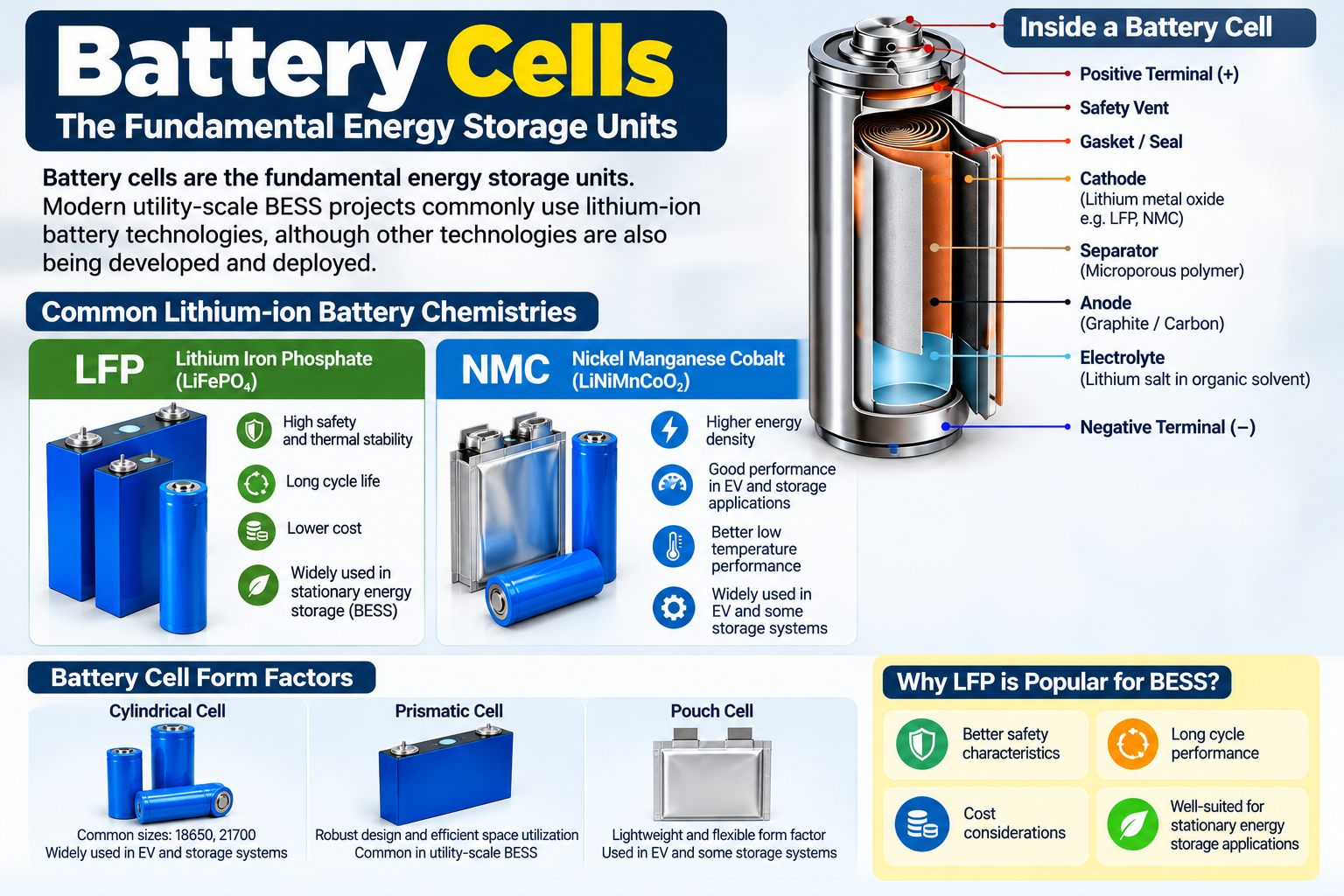
Battery cells are the fundamental energy storage units.
Modern utility-scale BESS projects commonly use lithium-ion battery technologies, although other technologies are also being developed and deployed.
Common lithium-ion chemistries include:
LFP — Lithium Iron Phosphate
NMC — Nickel Manganese Cobalt
LFP has become particularly important for stationary energy storage because of its combination of safety characteristics, cycle performance, and cost considerations.
2. Battery Module
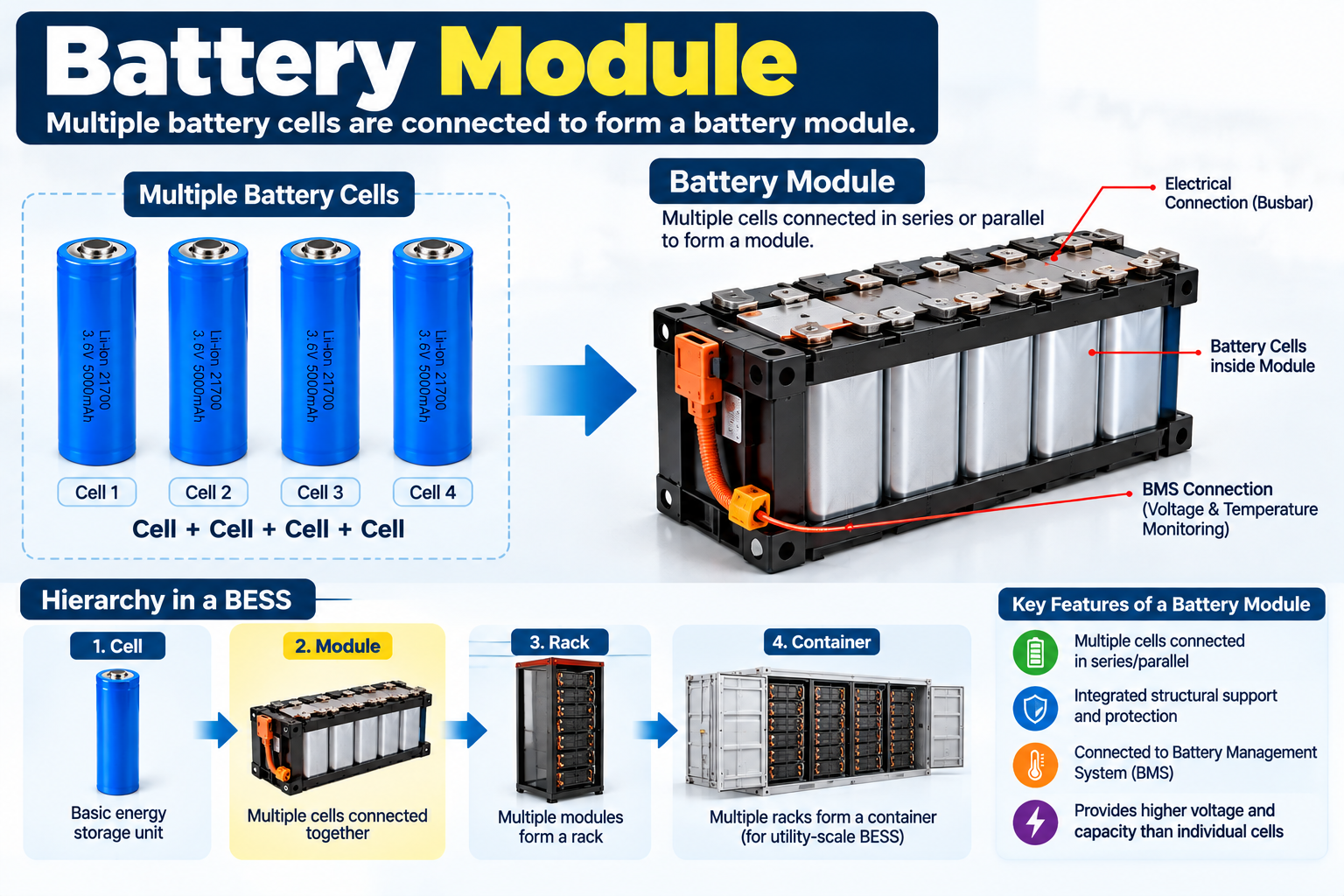
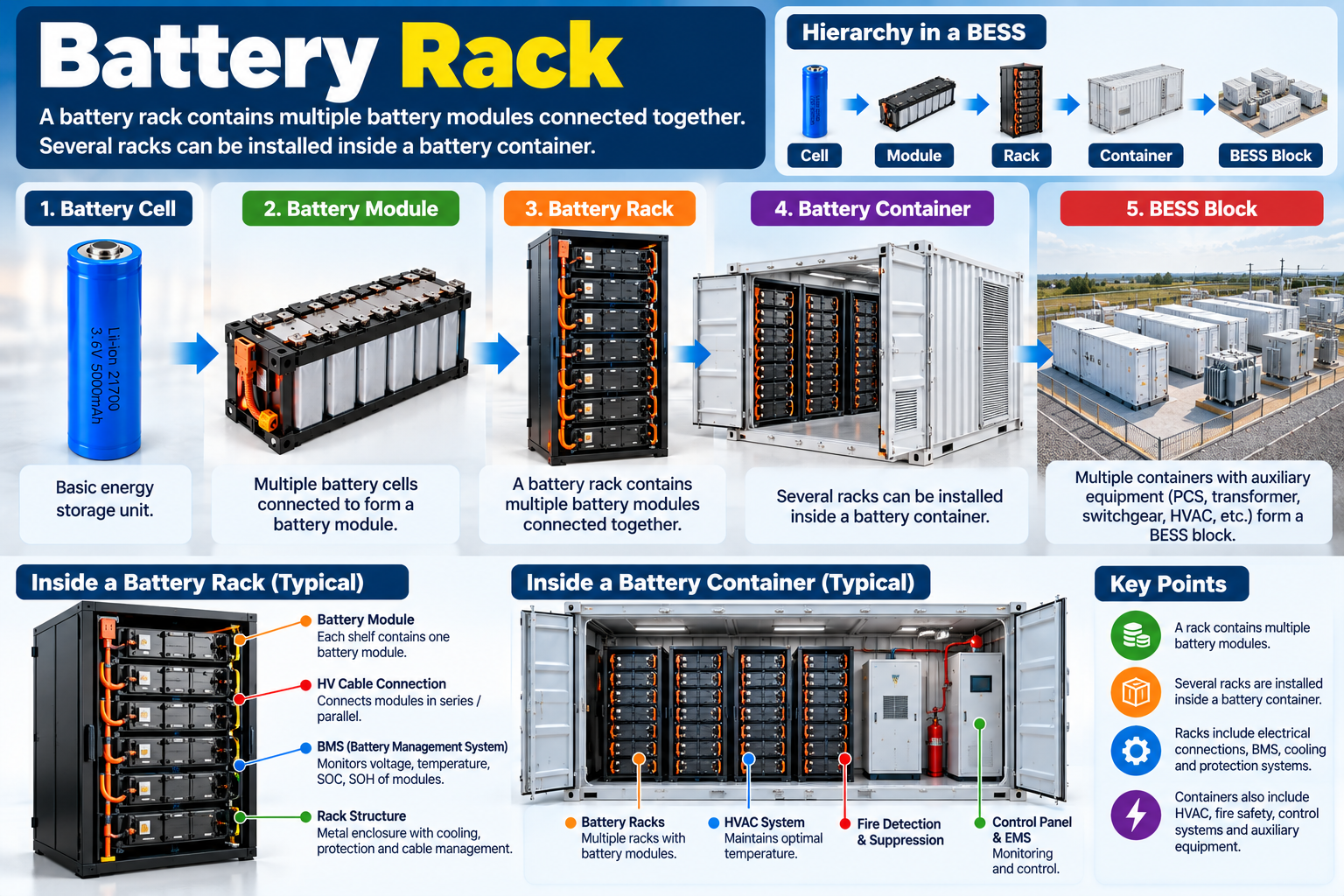
Multiple battery cells are connected to form a battery module.
Cell + Cell + Cell + Cell
↓
Battery Module
3. Battery Rack
A battery rack contains multiple battery modules connected together.Several racks can be installed inside a battery container.
Typical hierarchy:
Cell
↓
Module
↓
Rack
↓
Container
↓
BESS Block
4. Battery Management System — BMS
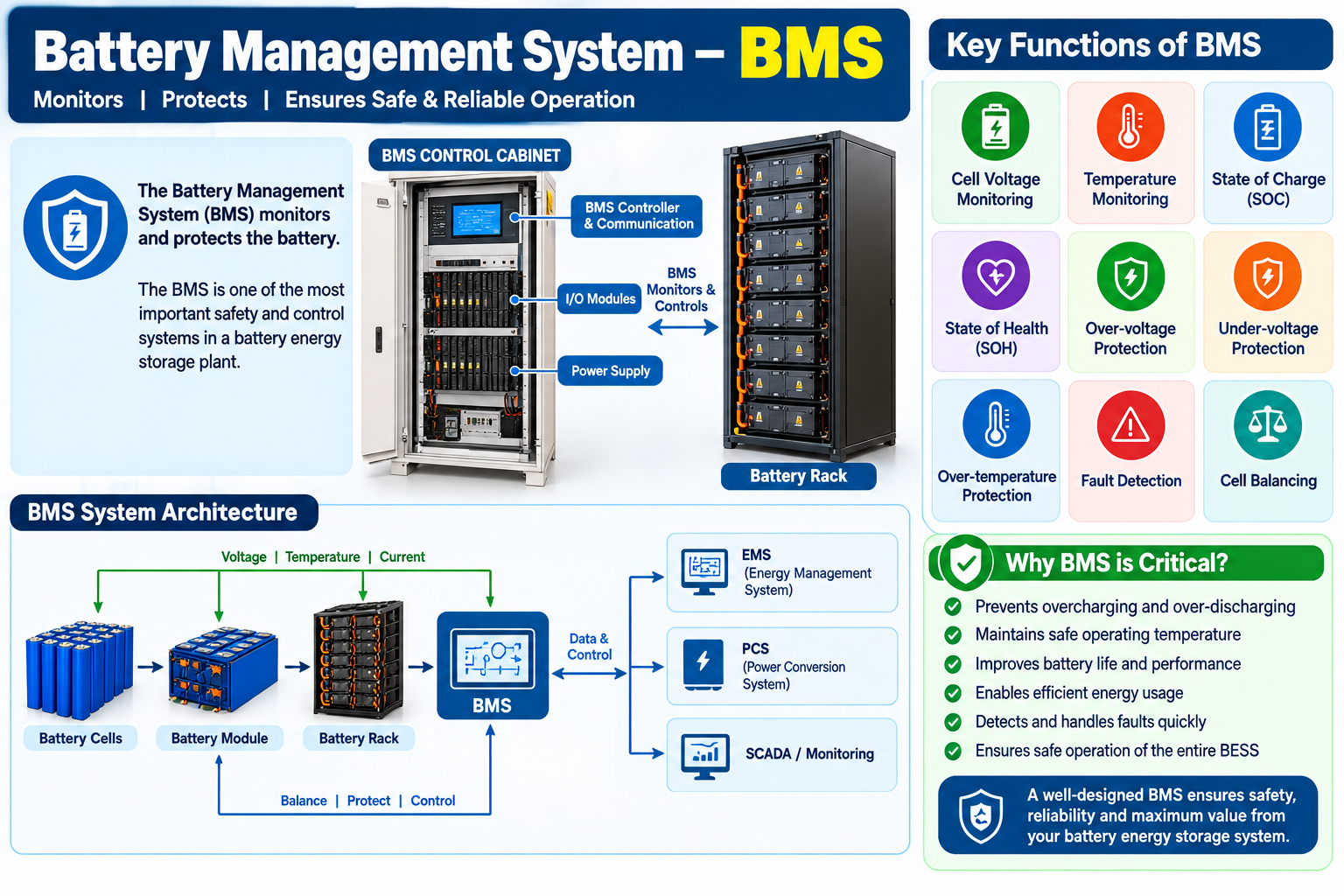
The Battery Management System (BMS) monitors and protects the battery.
Typical BMS functions include:
Cell voltage monitoring
Temperature monitoring
State of Charge (SOC)
State of Health (SOH)
Over-voltage protection
Under-voltage protection
Over-temperature protection
Fault detection
Cell balancing
The BMS is one of the most important safety and control systems in a battery energy storage plant.
5. Power Conversion System — PCS
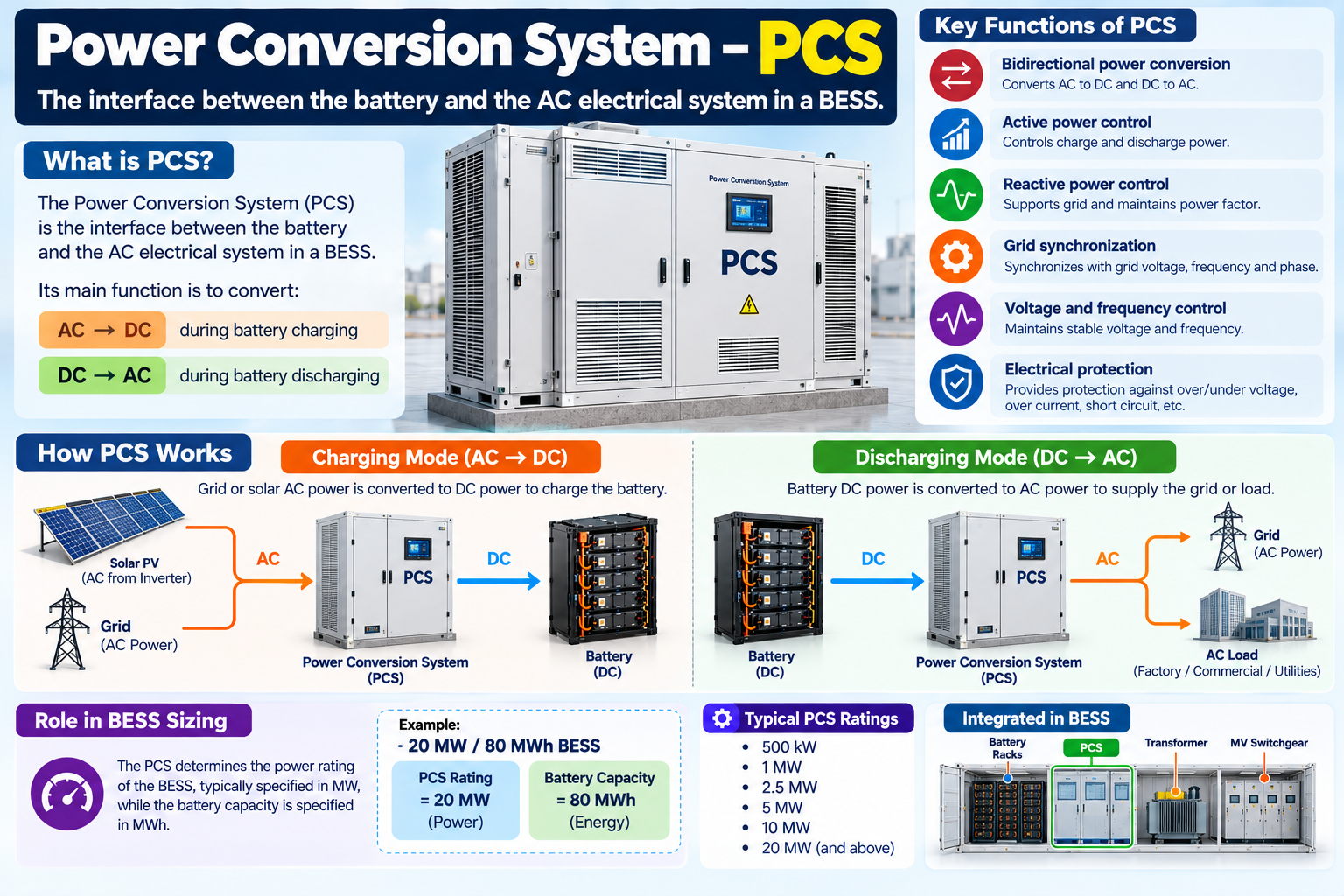
The Power Conversion System (PCS) is the interface between the battery and the AC electrical system in a BESS.
Its main function is to convert:
AC → DC during battery charging
DC → AC during battery discharging
Key Functions
Bidirectional power conversion
Active power control
Reactive power control
Grid synchronization
Voltage and frequency control
Electrical protection
Simple flow:
Grid/Solar → PCS → Battery (Charging)
Battery → PCS → Grid/Load (Discharging)
The PCS determines the power rating of the BESS, typically specified in MW, while the battery capacity is specified in MWh.
6. Energy Management System — EMS
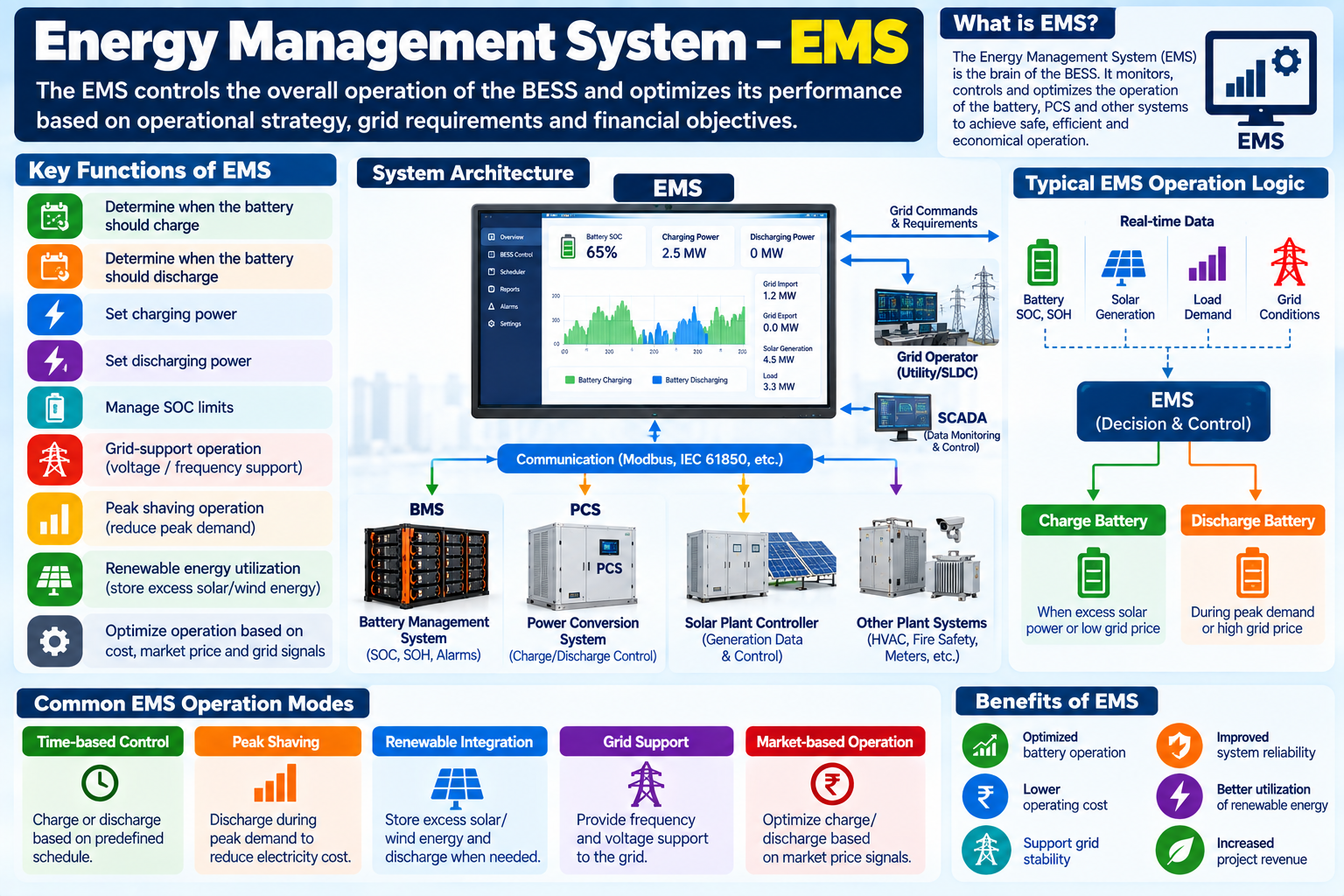
The EMS controls the overall operation of the BESS.
It can determine:
When the battery should charge
When the battery should discharge
Charging powerDischarging power
SOC limitsGrid-support operation
Peak shaving operation
Renewable energy utilization
The EMS can communicate with:
BMS
PCS
SCADA
Solar plant controller
Grid operator systems
7. HVAC System
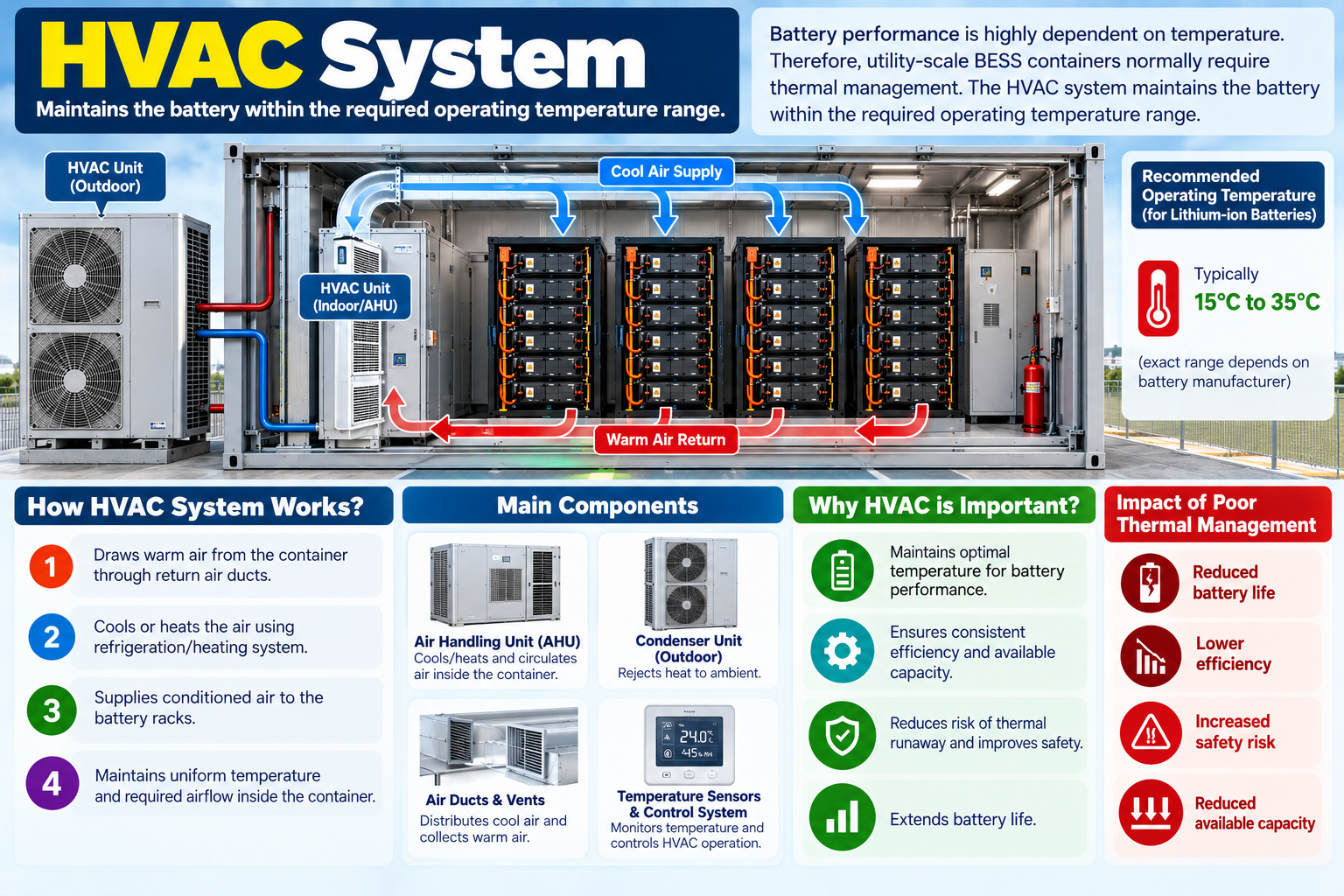
Battery performance is highly dependent on temperature.Therefore, utility-scale BESS containers normally require thermal management.The HVAC system maintains the battery within the required operating temperature range.Poor thermal management can negatively affect
:Battery life,fficiency,Safety,Available capacity.
8. Fire Detection and SuppressionSafety
is a critical consideration for BESS projects.A BESS installation may include: Smoke detection Temperature sensors Gas detection Fire detection Fire suppression systems Emergency shutdown Ventilation Thermal monitoringThe final system should be designed according to the applicable local regulations, fire codes, utility requirements, and equipment manufacturer's requirements.
What is BESS Capacity?
BESS capacity has two important parameters:
Power Capacity
Measured in: kW or MW
It represents how much power the battery can deliver at a given time.
Energy Capacity
Measured in:kWh or MWh
It represents how much energy the battery can store.
For example:
10 MW / 20 MWh BESS
The system has:
Power = 10 MW
Energy = 20 MWh
The theoretical duration is:
Duration=Energy/power
Duration=20/10=2 hours
Therefore, it is commonly described as a 2-hour BESS.
BESS Sizing Calculation
One of the basic approaches to estimate battery energy requirement is
BESS=Pload×T
Where:
E(BESS) = required battery energy
P(load) = required discharge power
T = required discharge duration
Example
Suppose a solar plant requires:25 MW discharge power
for:4 hours
Then: E=25×4
E = 100 MWh
Therefore, the nominal storage requirement is approximately:25 MW / 100 MWh
However, actual battery sizing must account for usable SOC range, efficiency, degradation, auxiliary consumption, temperature, reserve requirements, and other project-specific factors.
Important Factors in BESS Sizing
A professional BESS design should consider more than simply:
MW × hours
Important factors include:
1. Depth of Discharge — DoD
DoD indicates how much of the battery's available capacity is intended to be used.
For example, if the usable DoD is 90%, the battery should not normally be treated as having 100% of its nominal energy available for discharge.
2. Round-Trip Efficiency
Energy is lost during charging and discharging.For example, if:
Energy charged = 100 MWh
Round-trip efficiency = 90%
The energy available after a complete charge/discharge cycle would be lower than 100 MWh.
3. Battery Degradation
Battery capacity decreases over time.
Therefore, a BESS designed to meet a particular energy requirement at the end of its contractual life may require additional initial capacity.This is often referred to as:Augmentation
4. Auxiliary Consumption
Energy is also consumed by systems such as: HVAC BMS EMS Controls Lighting Fire protection Communication equipmentThese loads should be considered in the energy model.
State of Charge — SOC
SOC means State of Charge.
It represents the amount of energy currently stored in the battery relative to its usable capacity.
For example:
SOC = 100%
means the battery is fully charged within the defined operating limits.
SOC = 50%
means approximately half of the usable energy remains.
SOC = 20%
means the battery has relatively low remaining usable energy.BESS control strategies normally operate within defined SOC limits rather than continuously using the full theoretical battery range.
State of Health — SOH
SOH means State of Health.
It indicates the condition or remaining capacity of the battery compared with its initial condition.For example, if a battery originally has
:100 MWh
and its available capacity later reduces to
:85 MWhits capacity-based SOH would be approximately
:SOH=85/100×100
SOH=85%
Battery degradation should be included when evaluating long-term BESS performance.
Main Applications of BESS in Solar Plants
1. Energy Shifting
Store electricity during high solar generation and discharge it later.
This is one of the most common applications.
2. Peak Shaving
BESS can discharge during high-demand periods to reduce the amount of power drawn from the grid.
3. Grid Support
Depending on the system configuration and grid requirements, BESS may provide services such as: Frequency response Voltage support Reactive power support Ramp-rate control
4. Solar Power Plant Firming
Solar output can vary because of clouds and weather conditions.A BESS can be used to smooth or control plant output according to the project's operating requirements.
BESS DC/AC Ratio
When BESS is integrated with solar PV, the relationship between PV capacity, BESS power capacity, and battery energy capacity must be carefully evaluated.
For example:
Solar PV = 100 MWp
BESS PCS = 50 MW
BESS Energy = 200 MWh
This represents a:
50 MW / 200 MWh BESS
or approximately a:4-hour duration systemat full rated discharge power.The optimum configuration depends on the project's energy profile, grid connection, PPA, tariff structure, dispatch requirements, and technical specifications.
Advantages of BESS in Solar Power Plants
1. Better utilization of solar energy
Excess generation can potentially be stored instead of being curtailed.
2. Energy shifting
Solar energy generated during the day can be dispatched later.
3. Grid flexibility
BESS can respond quickly compared with many conventional generation technologies.
4. Peak demand management
Stored energy can be used during high-demand periods.5. Renewable integrationBESS can help manage variability from renewable generation.
Limitations of BESS
BESS also introduces additional considerations:
1High initial capital cost
Battery degradation
Thermal management requirements
Fire safety requirements
Replacement/augmentation requirements
Additional electrical equipment
Operational complexity
Recycling and end-of-life considerations
Therefore, BESS should be evaluated from both technical and economic perspectives.
Conclusion
Battery Energy Storage Systems can significantly change how solar power plants operate.A solar plant generates electricity primarily when sunlight is available, while BESS provides the ability to store energy and dispatch it later.For solar EPC engineers, understanding BESS requires knowledge of:
Battery sizing + PCS + BMS + EMS + electrical design + thermal management + safety + degradation + grid integration.The correct BESS configuration should always be selected based on the project's load profile, generation profile, grid requirements, operating strategy, technical specifications, degradation assumptions, and economic model.As solar generation continues to expand, BESS is becoming an increasingly important technology for building more flexible renewable-energy systems.