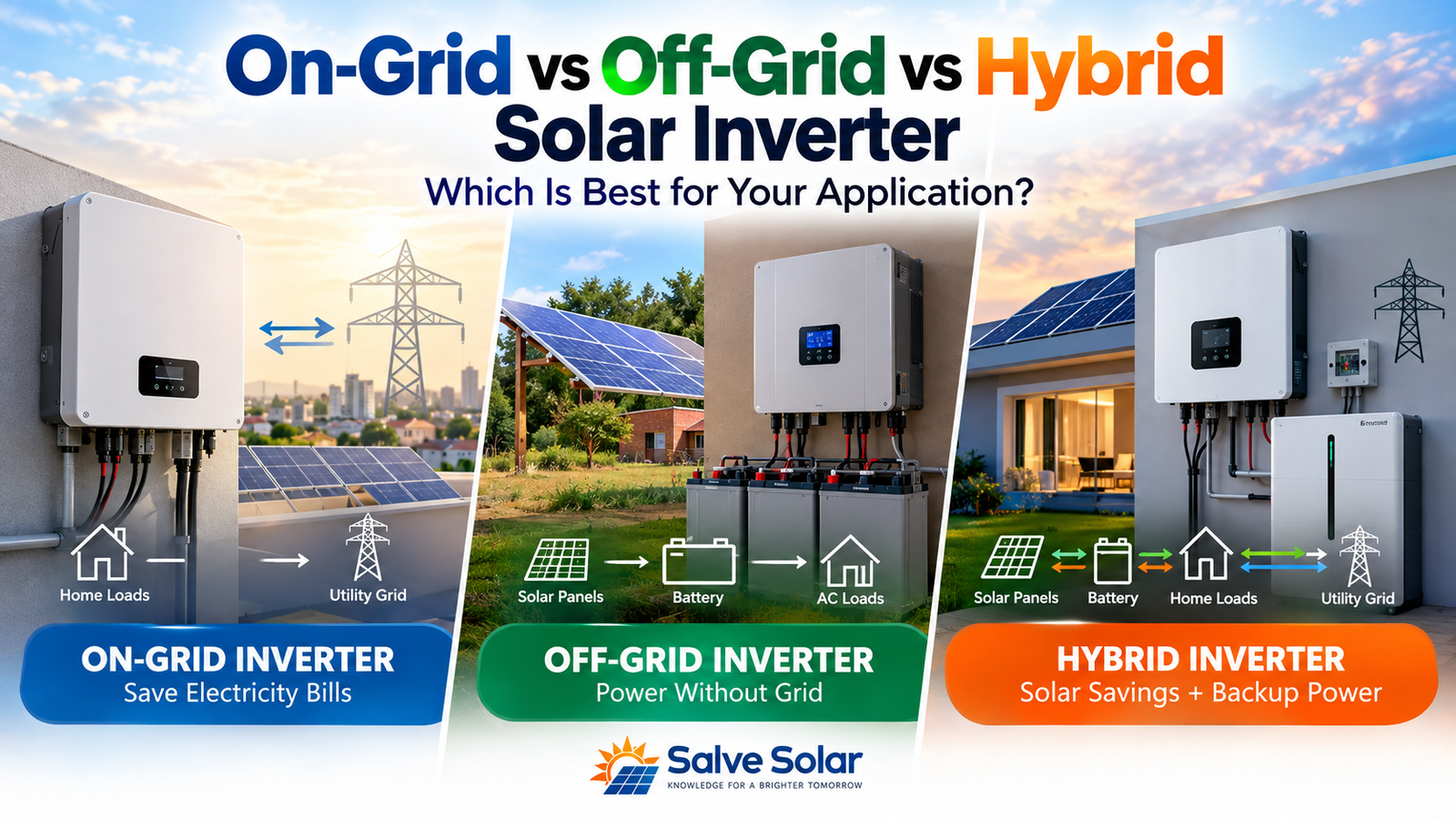
On-Grid vs Off-Grid vs Hybrid Solar Inverter: Which Is Best for Your Application?
Choosing a solar inverter is not simply about selecting a 3 kW, 5 kW, or 10 kW model. The correct choice depends on whether the installation needs grid export, battery backup, complete energy independence, or a combination of these functions.
For homeowners, commercial buildings, factories, farms, and solar EPC contractors, the three main options are on-grid, off-grid, and hybrid solar inverters. Each has a different electrical configuration, operating principle, and cost-performance trade-off
This guide compares all three inverter types from a practical solar engineering perspective, including system diagrams, sizing calculations, battery autonomy, use cases, and recommendations for selecting the right solution.
1. What Is the Difference Between On-Grid, Off-Grid and Hybrid Inverters?
A solar inverter converts DC electricity generated by solar panels into AC electricity. The main difference between these three inverter types is how they interact with the utility grid, battery storage, and electrical loads.
1.1 ON-grid inverter
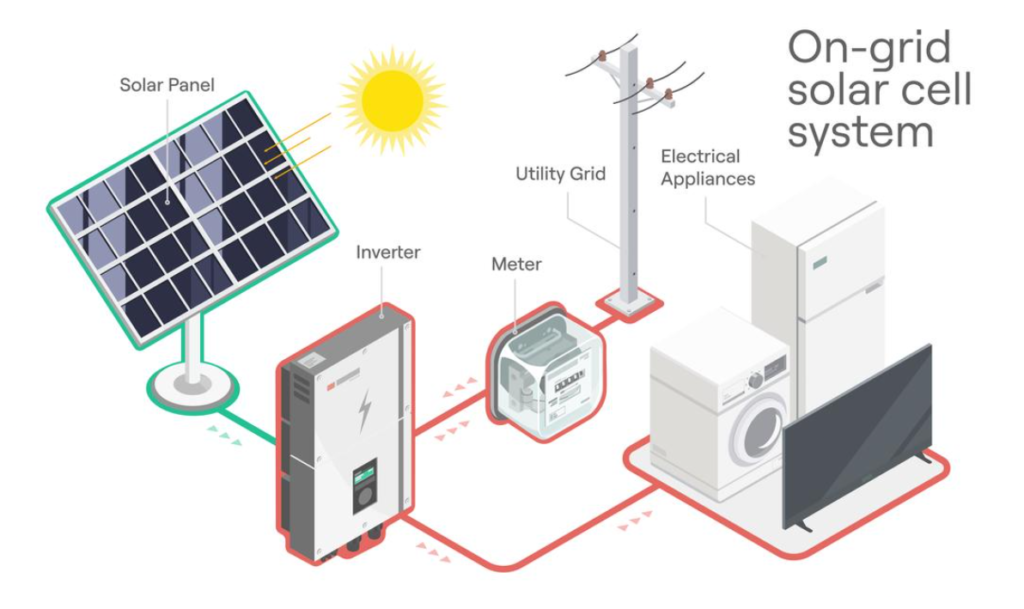
Working principle
Solar panels supply DC power to the grid-connected inverter. The inverter converts it to grid-synchronized AC power, which supplies local loads and can export surplus electricity to the utility grid when permitted.
Battery: Not required.
Grid connection: Required.
During a grid outage: A standard grid-following inverter shuts down because of anti-islanding protection.
Best application: Buildings with reliable grid supply and a primary goal of reducing electricity bills.
1.2 OFF-grid inverter
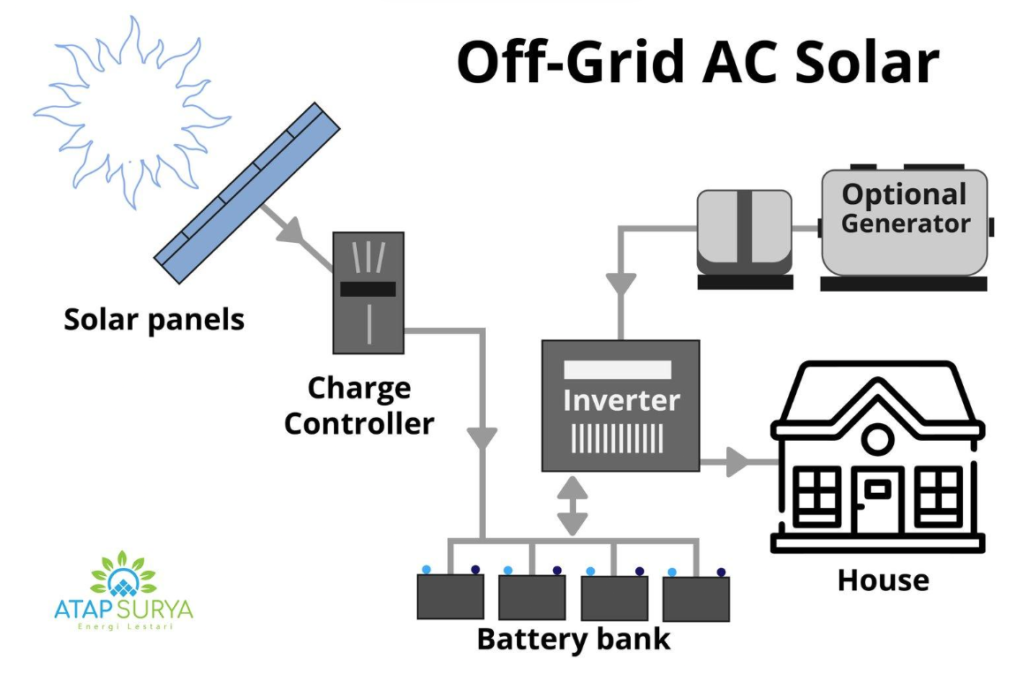
Working principle
Solar panels supply DC power to the system, which charges the battery and supplies the inverter. The inverter provides AC power to connected loads. When solar production is insufficient, the battery supplies the deficit, subject to its state of charge and power limits.
Battery: Required for typical solar-only systems designed to supply loads beyond sunshine hours.
Grid connection: Not required.
During a grid outage: Not applicable if the installation is independent of the grid.
Best application: Remote farms, isolated buildings, and sites without a usable grid connection.
1.3 Hybrid inverter
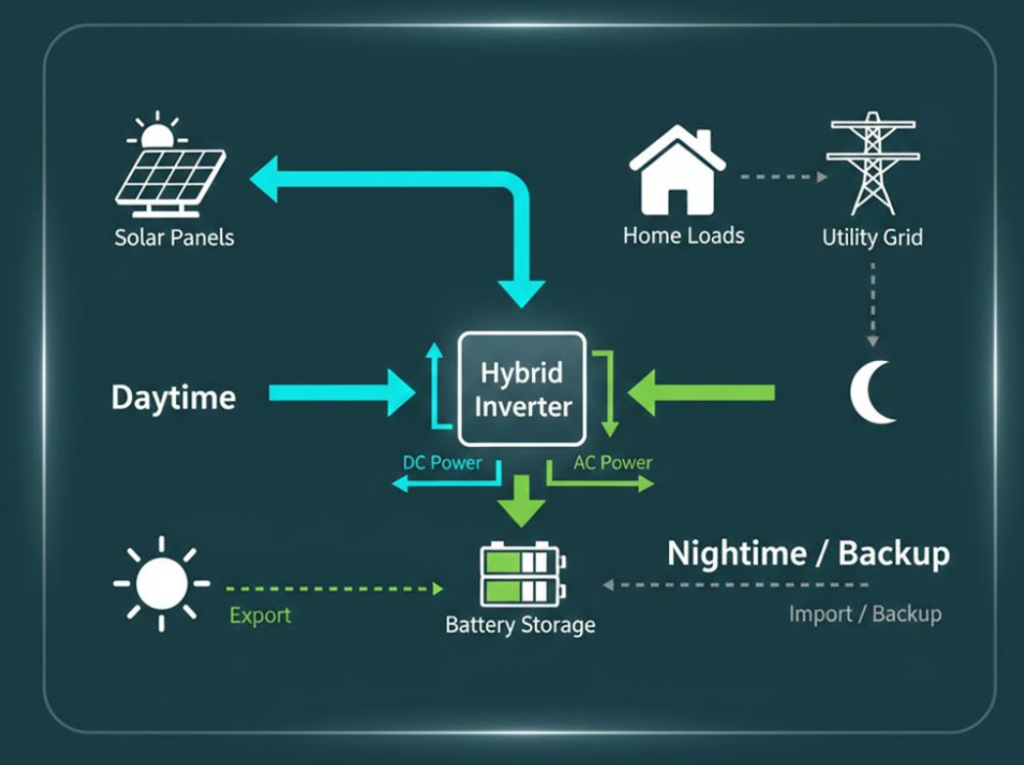
Working principle
A hybrid inverter coordinates solar generation, battery storage, connected loads, and the utility grid. Depending on the model and settings, solar power can supply loads, charge the battery, or export surplus. When the grid fails, a compatible system can isolate from the grid and supply designated backup loads
.Battery: Supported; optional on some models.
Grid connection: Used in grid-connected installations.
During a grid outage: Backup is available only if the system supports island operation and has suitable battery capacity.
Best application: Homes and businesses that want bill savings as well as backup power.
2. Complete Technical Comparison Table
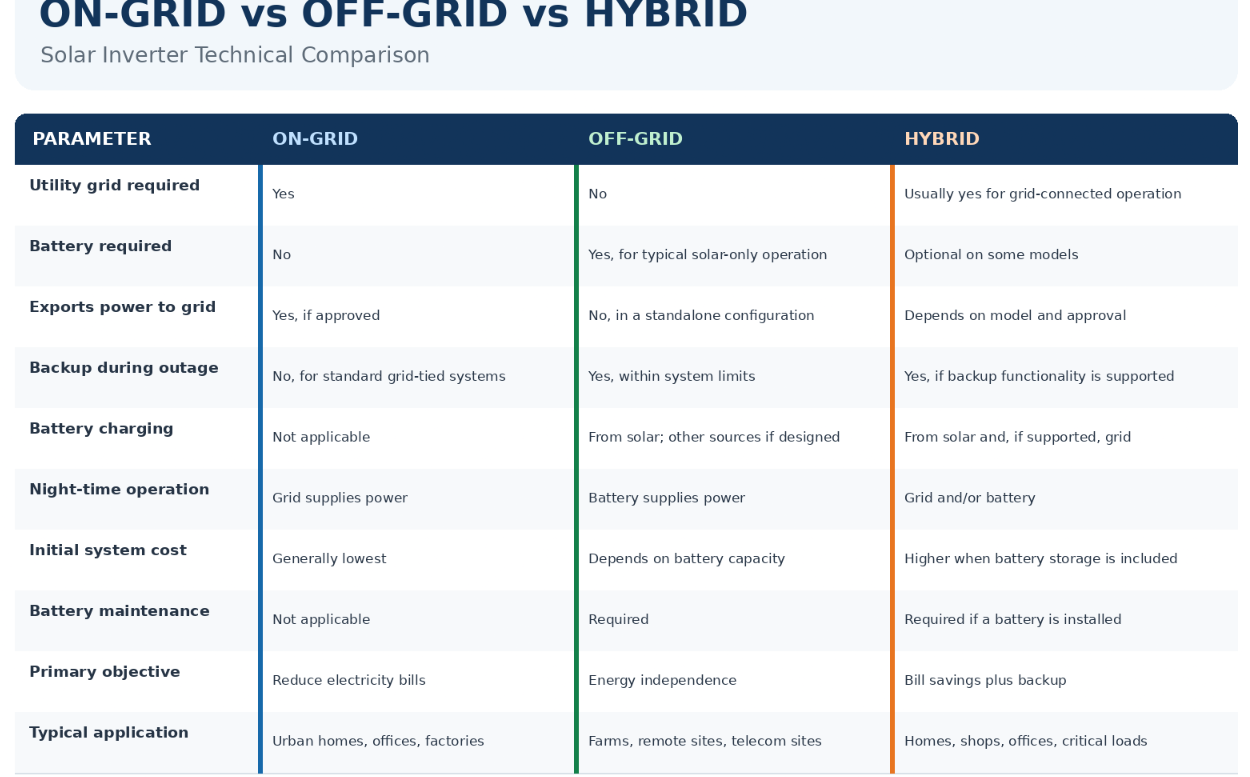
3. Practical Engineering Calculations
The following examples use illustrative values to explain how engineers estimate system capacity. They are not final equipment selections.
Example 1: Selecting an on-grid inverter for a rooftop systemAssume:
PV module capacity: 5.4 kWp DC
Proposed inverter capacity: 5 kW AC
The DC/AC ratio is: 5.4/5=1.08
Therefore, the proposed system has a DC/AC ratio of 1.08.This is a reasonable starting point for evaluation, but the final selection must also satisfy the inverter's maximum DC voltage, MPPT operating range, input-current limits, temperature conditions, and applicable grid-connection requirements.
Recommendation: Use an on-grid inverter when the primary objective is to reduce electricity bills and battery backup is not required.
4. Important Checks Before Purchasing an Inverter
Regardless of the inverter type, verify the following items in the manufacturer's datasheet:
1.Rated AC output power: Match the intended load and operating conditions.
2.Maximum DC input voltage: Check maximum PV string open-circuit voltage at the minimum design temperature.
3.MPPT voltage range: Ensure the string operating voltage stays within the permitted range.
4.Maximum input and short-circuit current: Check every MPPT against the proposed string configuration.
5.Battery compatibility: For off-grid and hybrid systems, verify battery voltage, chemistry, BMS communication, charging limits, and approved battery models.
6.Backup output: Check continuous power, surge capability, supported phases, transfer behaviour, and which circuits can be supplied during an outage.
7.Protection and compliance: Confirm anti-islanding, earthing, surge protection, grid-code compliance, and required utility approvals
8.Monitoring and service: Review remote monitoring, warranty terms, spare-parts availability, and local service support.
5. Frequently Asked Questions
Q1. Which inverter is best for a home in India?
An on-grid inverter is usually a strong choice when grid supply is reliable and electricity-bill savings are the priority. A hybrid inverter is more appropriate when backup during power cuts is important. An off-grid inverter is intended for installations that must operate independently of the utility grid.
Q2. Can an on-grid inverter work during a power cut?
A standard grid-following inverter shuts down when the utility grid fails, even if sunlight is available. Special backup systems require additional compatible equipment and an approved design; ordinary on-grid operation should not be assumed to provide backup.
Q3. Is a battery compulsory for a hybrid inverter?
Not for every hybrid model or operating mode. However, a battery is generally necessary if you want the system to supply stored energy during a grid outage after solar generation becomes insufficient. Check the manufacturer's specified operating modes.
Q4. Can an off-grid inverter export electricity to the grid?
A standalone off-grid inverter is not designed to export power to the utility grid. Grid export requires equipment and an interconnection arrangement designed and approved for that purpose.
Q5. Which inverter is best for a solar water pump?
The answer depends on the pumping system. A dedicated solar pump inverter or variable-frequency drive designed for PV input may be more appropriate than a conventional household inverter. If the pump needs battery-free daytime operation, check its starting power, motor compatibility, and solar input requirements.
Q6. Which inverter is best for a factory?
For factories mainly looking to reduce daytime energy costs, an on-grid system may be suitable. If uninterrupted operation of critical equipment is required, consider a properly engineered hybrid or industrial battery storage system. Motor starting currents and three-phase load requirements must be evaluated.
Q7. Which system has the lowest maintenance requirements?
An on-grid system without batteries generally has fewer components to maintain. Off-grid and hybrid systems with batteries require additional monitoring and maintenance, and batteries may need replacement during the system's service life.
Conclusion: Our Recommendation
There is no single inverter type that is best for every application. The correct selection depends on the site's grid availability, backup requirement, daily energy consumption, budget, and electrical design.
Choose on-grid for reliable-grid locations where the main goal is reducing electricity bills.
Choose off-grid for remote locations where independent power supply is necessary.
Choose hybrid when grid-connected solar savings and battery backup are both required.
For solar EPC contractors and design engineers, the selection should be supported by load calculations, PV string-voltage checks, battery autonomy calculations, equipment compatibility checks, and compliance with applicable grid-interconnection requirements.At Salve Solar, our goal is to help solar professionals make better engineering decisions through practical guides on inverter selection, solar plant design, electrical calculations, PVsyst, and renewable energy systems.